← All tools

Refuture Africa / Online preview / Version 1.1

System and Value Flow Map

Trace materials, money, services, knowledge and decision rights. Identify who benefits, who carries costs and which relationship needs attention.

Read all 7 pages below, including the guide, worksheets and examples. This preview is read-only. To complete the worksheets, download the fillable PDF with your name and email.

On a small screen, open a full-size page to zoom, or expand its text view. The PDFs are not fully tagged for screen readers. Use the online text view if it works better with your assistive technology.

Worked examples use a fictional solar irrigation service. Assumptions, proposals and simulated results are labelled in the tools.

Facilitator guide: prepare and run a session

Prepare

For business, design and strategy teams working with people across a value chain or place. Allow 75-120 min. Invite people affected by the decision and people who can explain how delivery, money and decision rights work. Agree consent, attribution and how disagreements will be recorded.

Bring relevant evidence with sources and dates, a printed worksheet or a PDF editor, and a way to record unresolved questions. Read the teaching example beforehand; its invented figures are not benchmarks.

Run the session

  1. Set the boundary and invite the right knowledge

    Choose a real decision. Start with six actors or living systems; add a continuation sheet where the boundary omits a consequential relationship.

  2. Draw distinct, directed flows

    Give each arrow an ID, F01 onwards. Keep material, money, knowledge, service and decision rights distinct. Draw a separate return arrow rather than implying an exchange is balanced.

  3. Make the terms visible in the register

    Match every arrow to a row. State its direction, category, quantity or unit and period; identify who controls terms and who benefits or bears costs.

  4. Check and choose a leverage question

    Ask those shown, especially people with less influence, to challenge the map. Mark K = known, A = assumed or ? = to explore with a source/date. Choose one change and the evidence it needs.

Check the quality

Revenue leaving a place can pay for useful work; local retention can still be unfair. Examine the price, access, rights, dependency and ecological consequences. More arrows or a balanced-looking map do not demonstrate shared value or regeneration.

Separate what is known, assumed and still to explore. Invite a different view before agreeing the next action. A proposed commitment stays a proposal until the responsible people confirm it.

Close and follow through

Read back the decision, evidence gaps, owner, resources and review date. Record what would make the team pause or change course. Share the record with participants and confirm corrections.

Use the worksheet

Page 2 is the A3 map; page 3 is its fillable A3 flow register. Pages 5-6 show a matching example. Draw with PDF annotations or on paper; use the fields for brief notes. Reuse blank sheets to extend the system. Save and reopen to check entries.

System and Value Flow Map — page 1: Tool guide
Read page 1 as text

Text follows the PDF’s reading order; use the page image to see relationships and table columns.

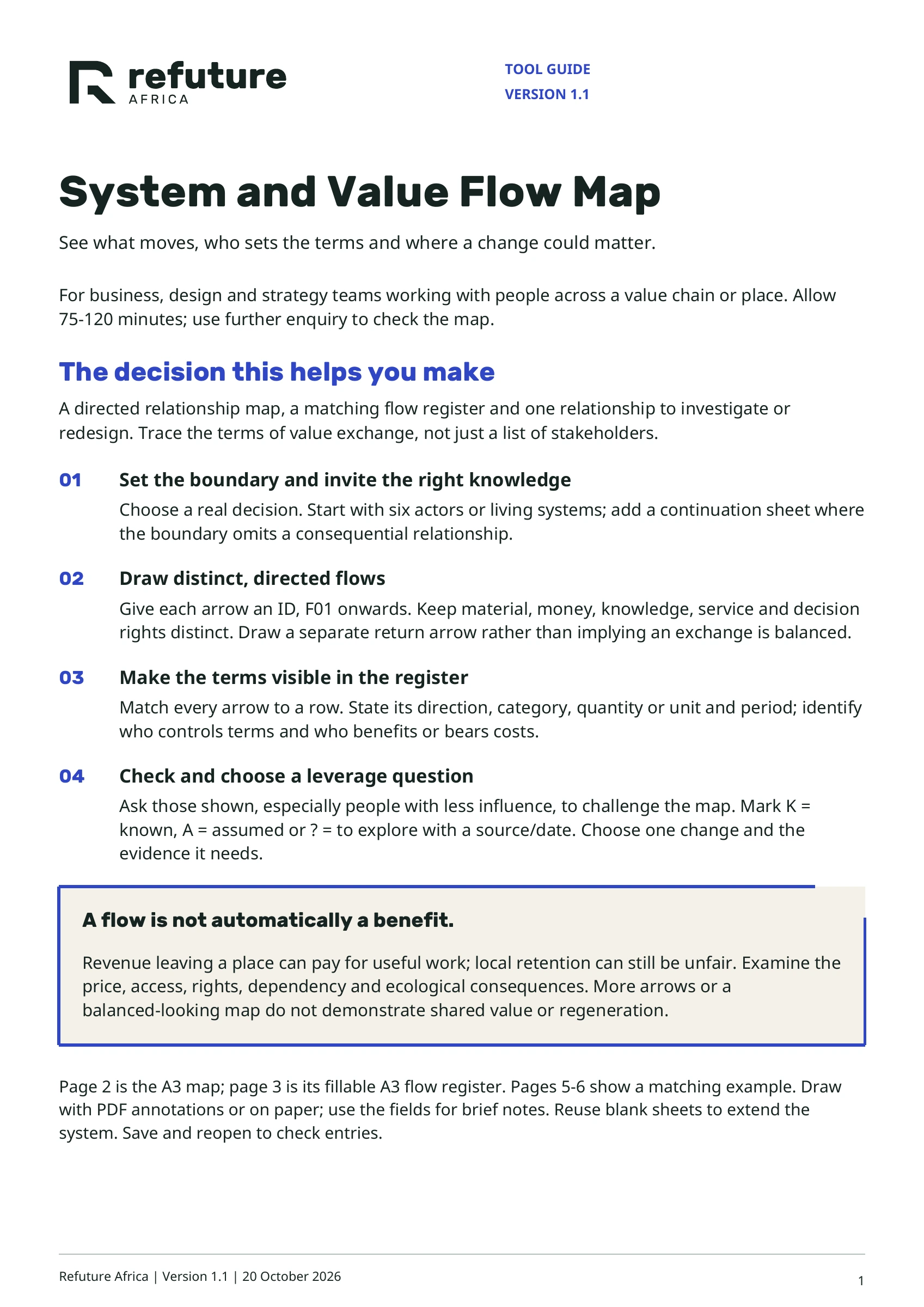
TOOL GUIDE VERSION 1.1 System and Value Flow Map See what moves, who sets the terms and where a change could matter. For business, design and strategy teams working with people across a value chain or place. Allow 75-120 minutes; use further enquiry to check the map. The decision this helps you make A directed relationship map, a matching flow register and one relationship to investigate or redesign. Trace the terms of value exchange, not just a list of stakeholders. 01 Set the boundary and invite the right knowledge Choose a real decision. Start with six actors or living systems; add a continuation sheet where the boundary omits a consequential relationship. 02 Draw distinct, directed flows Give each arrow an ID, F01 onwards. Keep material, money, knowledge, service and decision rights distinct. Draw a separate return arrow rather than implying an exchange is balanced. 03 Make the terms visible in the register Match every arrow to a row. State its direction, category, quantity or unit and period; identify who controls terms and who benefits or bears costs. 04 Check and choose a leverage question Ask those shown, especially people with less influence, to challenge the map. Mark K = known, A = assumed or ? = to explore with a source/date. Choose one change and the evidence it needs. A flow is not automatically a benefit. Revenue leaving a place can pay for useful work; local retention can still be unfair. Examine the price, access, rights, dependency and ecological consequences. More arrows or a balanced-looking map do not demonstrate shared value or regeneration. Page 2 is the A3 map; page 3 is its fillable A3 flow register. Pages 5-6 show a matching example. Draw with PDF annotations or on paper; use the fields for brief notes. Reuse blank sheets to extend the system. Save and reopen to check entries. Refuture Africa | Version 1.1 | 20 October 2026 1

2 / Fillable relationship map

Open full-size page 2 in a new tab ↗
System and Value Flow Map — page 2: Fillable relationship map
Read page 2 as text

Text follows the PDF’s reading order; use the page image to see relationships and table columns.

Worksheet entry labels

These labels identify the blank fields in this worksheet. Repeated row labels belong to separate entries.

  1. Decision and scope
  2. Place and period
  3. People and date
  4. Actor A / person, organisation or living system
  5. Actor B / person, organisation or living system
  6. Actor C / person, organisation or living system
  7. Actor D / person, organisation or living system
  8. Actor E / person, organisation or living system
  9. Actor F / person, organisation or living system
  10. Directed relationships and flow IDs
  11. Priority question or change
  12. Next evidence and decision
  13. Owner and participants
  14. Review point and trigger
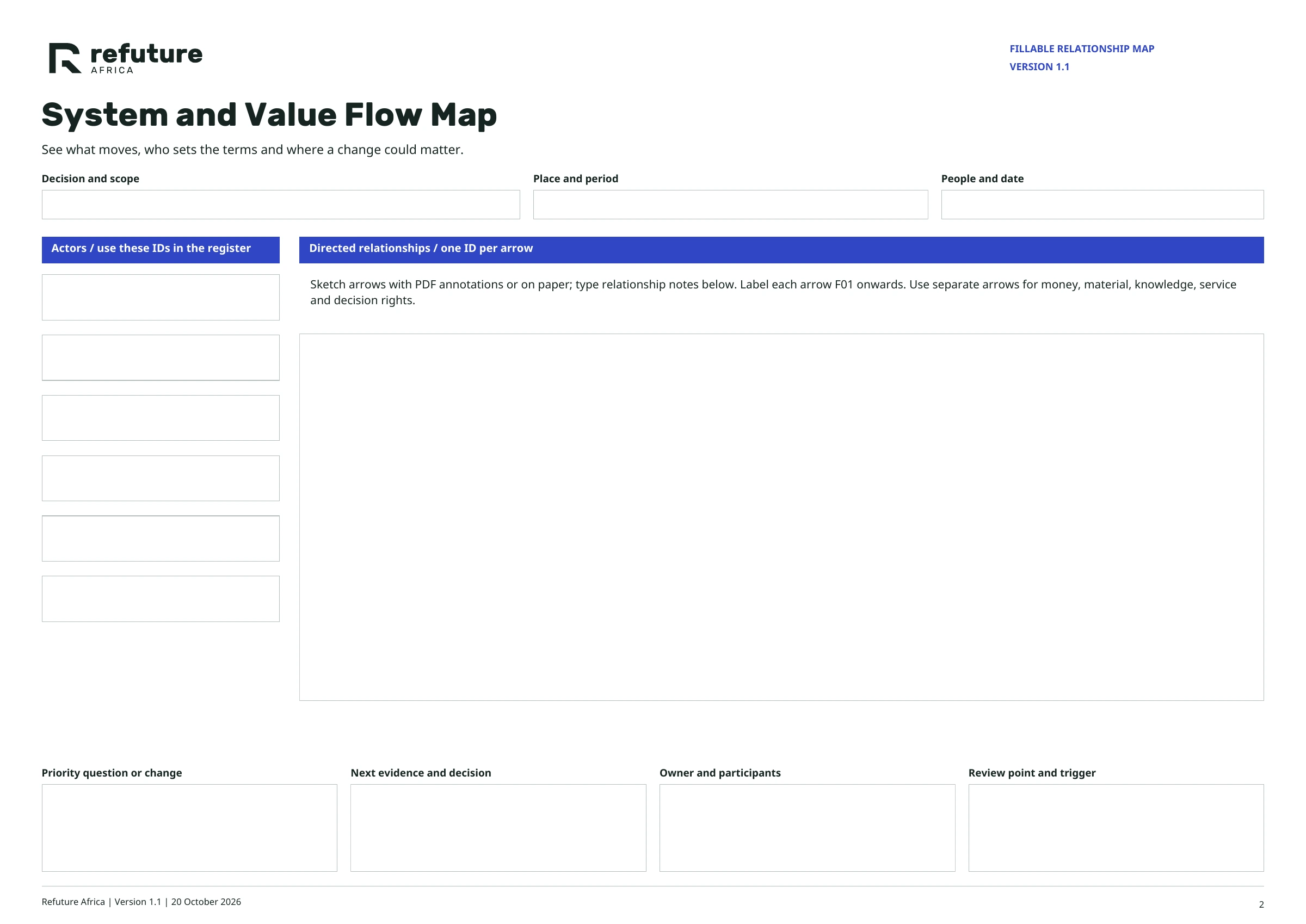
FILLABLE RELATIONSHIP MAP VERSION 1.1 System and Value Flow Map See what moves, who sets the terms and where a change could matter. Decision and scope Place and period People and date Actors / use these IDs in the register Directed relationships / one ID per arrow Sketch arrows with PDF annotations or on paper; type relationship notes below. Label each arrow F01 onwards. Use separate arrows for money, material, knowledge, service and decision rights. Priority question or change Next evidence and decision Owner and participants Review point and trigger Refuture Africa | Version 1.1 | 20 October 2026 2

3 / Fillable flow register

Open full-size page 3 in a new tab ↗
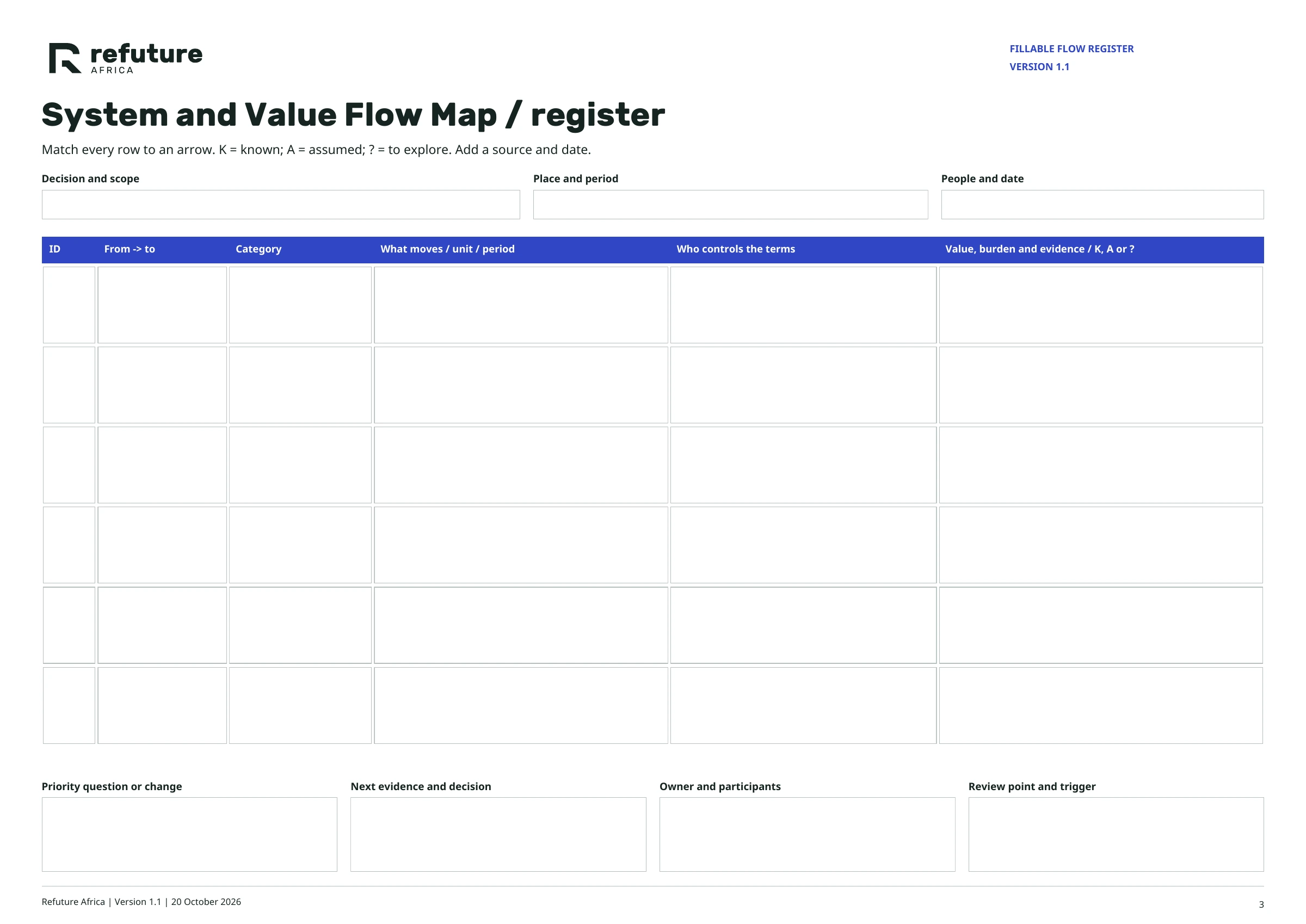
System and Value Flow Map — page 3: Fillable flow register
Read page 3 as text

Text follows the PDF’s reading order; use the page image to see relationships and table columns.

Worksheet entry labels

These labels identify the blank fields in this worksheet. Repeated row labels belong to separate entries.

  1. Decision and scope
  2. Place and period
  3. People and date
  4. ID, row 1
  5. From -> to, row 1
  6. Category, row 1
  7. What moves / unit / period, row 1
  8. Who controls the terms, row 1
  9. Value, burden and evidence / K, A or ?, row 1
  10. ID, row 2
  11. From -> to, row 2
  12. Category, row 2
  13. What moves / unit / period, row 2
  14. Who controls the terms, row 2
  15. Value, burden and evidence / K, A or ?, row 2
  16. ID, row 3
  17. From -> to, row 3
  18. Category, row 3
  19. What moves / unit / period, row 3
  20. Who controls the terms, row 3
  21. Value, burden and evidence / K, A or ?, row 3
  22. ID, row 4
  23. From -> to, row 4
  24. Category, row 4
  25. What moves / unit / period, row 4
  26. Who controls the terms, row 4
  27. Value, burden and evidence / K, A or ?, row 4
  28. ID, row 5
  29. From -> to, row 5
  30. Category, row 5
  31. What moves / unit / period, row 5
  32. Who controls the terms, row 5
  33. Value, burden and evidence / K, A or ?, row 5
  34. ID, row 6
  35. From -> to, row 6
  36. Category, row 6
  37. What moves / unit / period, row 6
  38. Who controls the terms, row 6
  39. Value, burden and evidence / K, A or ?, row 6
  40. Priority question or change
  41. Next evidence and decision
  42. Owner and participants
  43. Review point and trigger
FILLABLE FLOW REGISTER VERSION 1.1 System and Value Flow Map / register Match every row to an arrow. K = known; A = assumed; ? = to explore. Add a source and date. Decision and scope Place and period People and date ID From -> to Category What moves / unit / period Who controls the terms Value, burden and evidence / K, A or ? Priority question or change Next evidence and decision Owner and participants Review point and trigger Refuture Africa | Version 1.1 | 20 October 2026 3

4 / Shared fictional teaching case

Open full-size page 4 in a new tab ↗
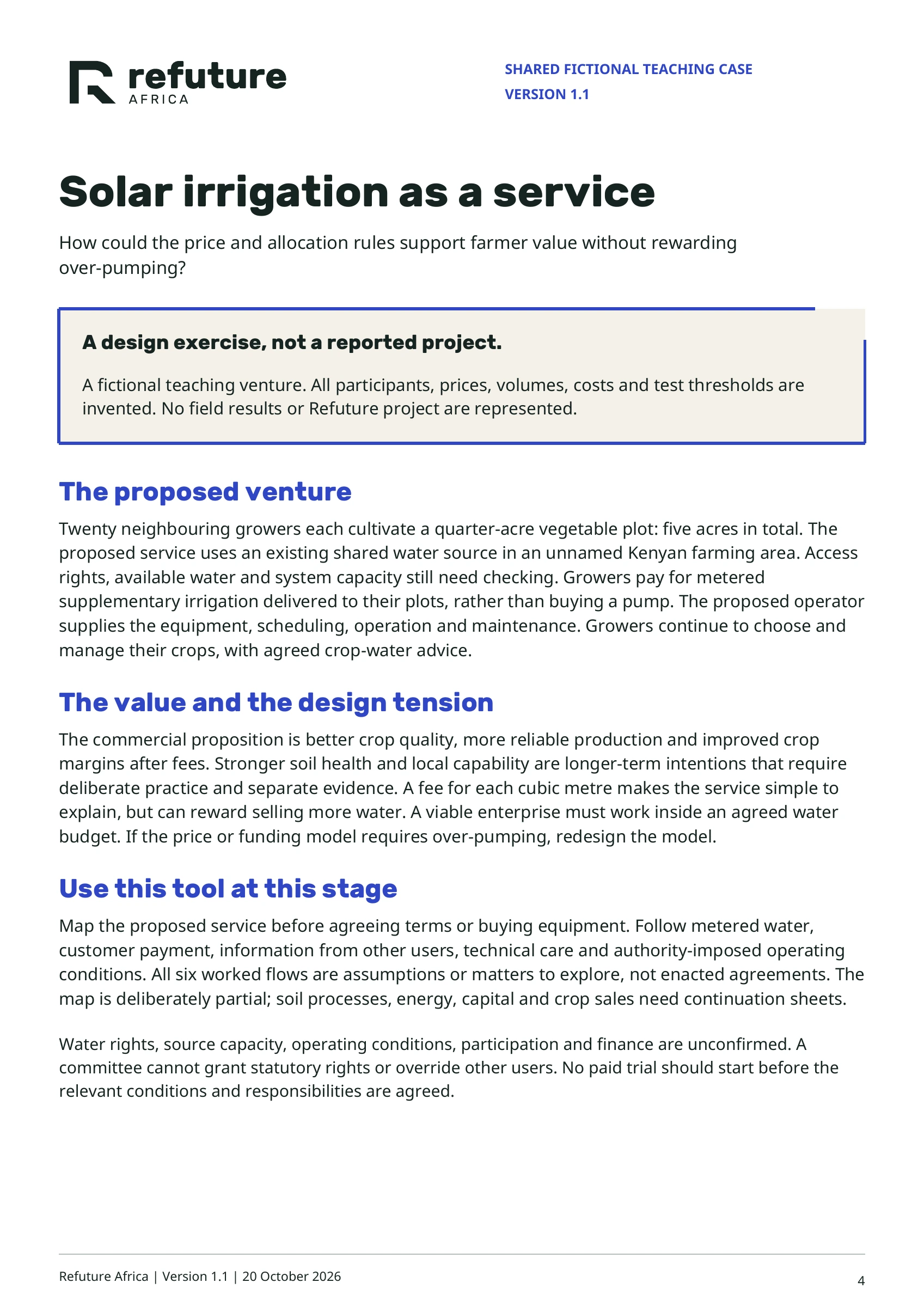
System and Value Flow Map — page 4: Shared fictional teaching case
Read page 4 as text

Text follows the PDF’s reading order; use the page image to see relationships and table columns.

SHARED FICTIONAL TEACHING CASE VERSION 1.1 Solar irrigation as a service How could the price and allocation rules support farmer value without rewarding over-pumping? A design exercise, not a reported project. A fictional teaching venture. All participants, prices, volumes, costs and test thresholds are invented. No field results or Refuture project are represented. The proposed venture Twenty neighbouring growers each cultivate a quarter-acre vegetable plot: five acres in total. The proposed service uses an existing shared water source in an unnamed Kenyan farming area. Access rights, available water and system capacity still need checking. Growers pay for metered supplementary irrigation delivered to their plots, rather than buying a pump. The proposed operator supplies the equipment, scheduling, operation and maintenance. Growers continue to choose and manage their crops, with agreed crop-water advice. The value and the design tension The commercial proposition is better crop quality, more reliable production and improved crop margins after fees. Stronger soil health and local capability are longer-term intentions that require deliberate practice and separate evidence. A fee for each cubic metre makes the service simple to explain, but can reward selling more water. A viable enterprise must work inside an agreed water budget. If the price or funding model requires over-pumping, redesign the model. Use this tool at this stage Map the proposed service before agreeing terms or buying equipment. Follow metered water, customer payment, information from other users, technical care and authority-imposed operating conditions. All six worked flows are assumptions or matters to explore, not enacted agreements. The map is deliberately partial; soil processes, energy, capital and crop sales need continuation sheets. Water rights, source capacity, operating conditions, participation and finance are unconfirmed. A committee cannot grant statutory rights or override other users. No paid trial should start before the relevant conditions and responsibilities are agreed. Refuture Africa | Version 1.1 | 20 October 2026 4
System and Value Flow Map — page 5: Worked map
Read page 5 as text

Text follows the PDF’s reading order; use the page image to see relationships and table columns.

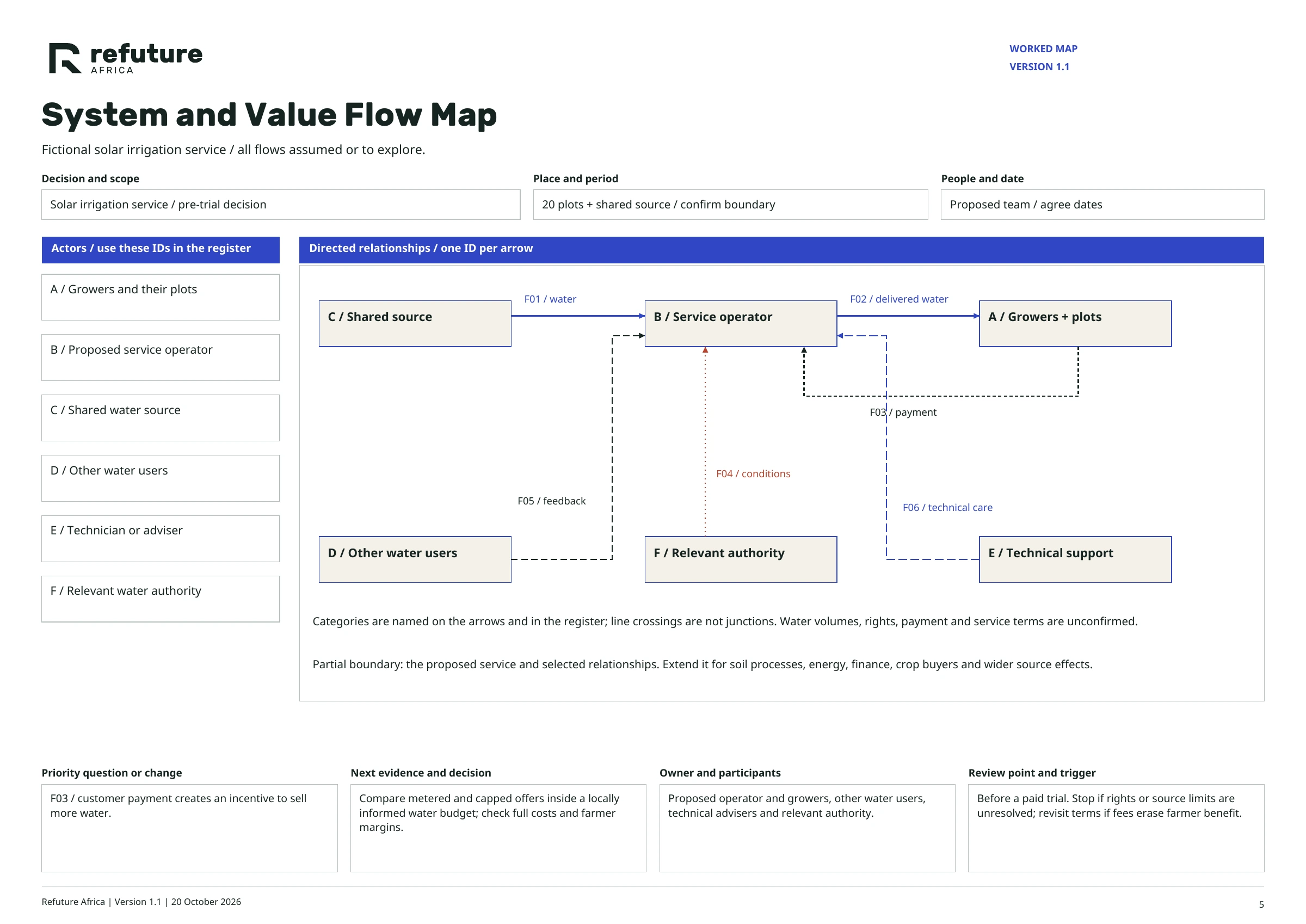
WORKED MAP VERSION 1.1 System and Value Flow Map Fictional solar irrigation service / all flows assumed or to explore. Decision and scope Solar irrigation service / pre-trial decision Place and period 20 plots + shared source / confirm boundary People and date Proposed team / agree dates Actors / use these IDs in the register A / Growers and their plots B / Proposed service operator C / Shared water source D / Other water users E / Technician or adviser F / Relevant water authority Directed relationships / one ID per arrow C / Shared source B / Service operator A / Growers + plots D / Other water users F / Relevant authority E / Technical support F01 / water F02 / delivered water F03 / payment F04 / conditions F05 / feedback F06 / technical care Categories are named on the arrows and in the register; line crossings are not junctions. Water volumes, rights, payment and service terms are unconfirmed. Partial boundary: the proposed service and selected relationships. Extend it for soil processes, energy, finance, crop buyers and wider source effects. Priority question or change F03 / customer payment creates an incentive to sell more water. Next evidence and decision Compare metered and capped offers inside a locally informed water budget; check full costs and farmer margins. Owner and participants Proposed operator and growers, other water users, technical advisers and relevant authority. Review point and trigger Before a paid trial. Stop if rights or source limits are unresolved; revisit terms if fees erase farmer benefit. Refuture Africa | Version 1.1 | 20 October 2026 5
System and Value Flow Map — page 6: Worked flow register
Read page 6 as text

Text follows the PDF’s reading order; use the page image to see relationships and table columns.

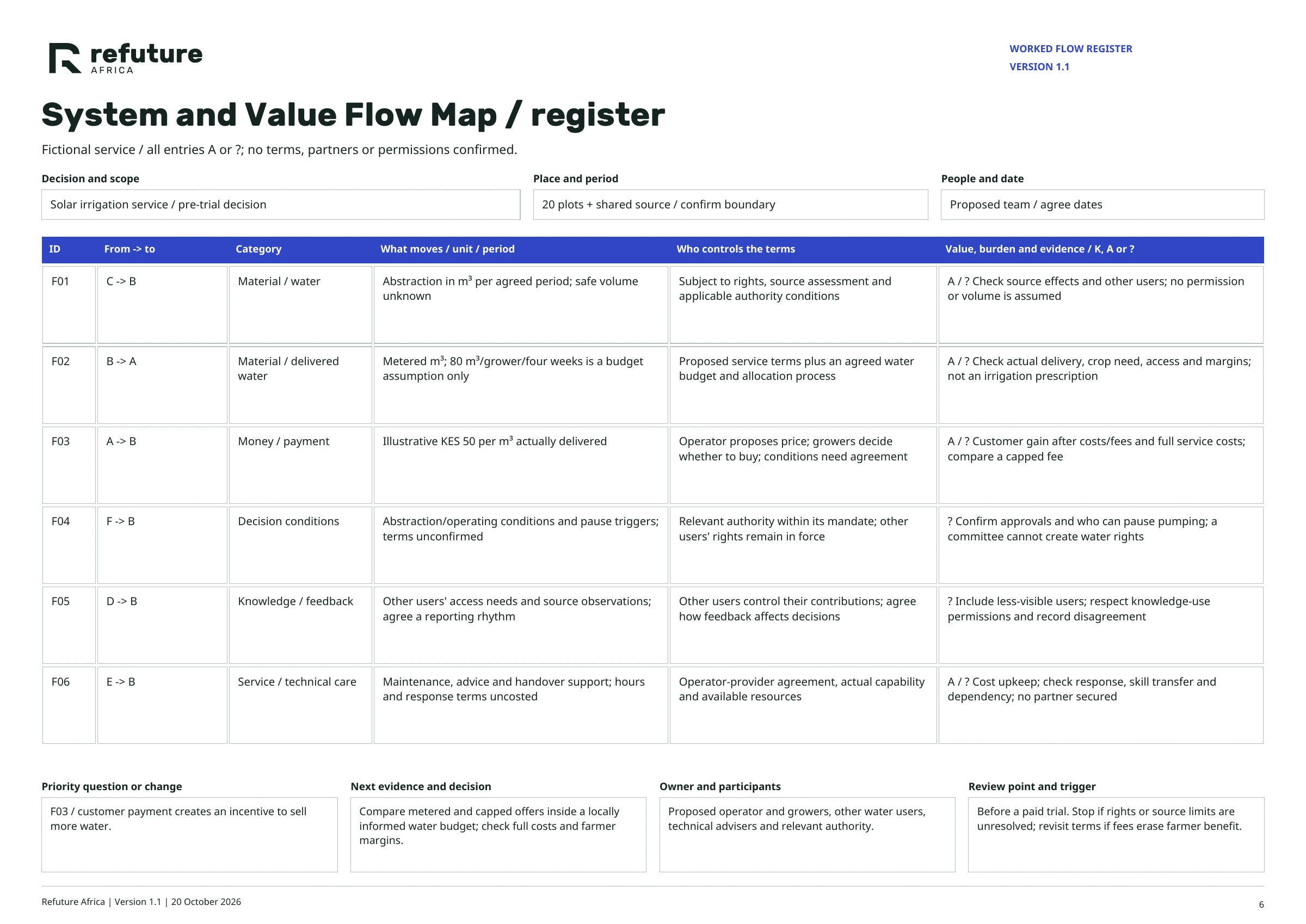
WORKED FLOW REGISTER VERSION 1.1 System and Value Flow Map / register Fictional service / all entries A or ?; no terms, partners or permissions confirmed. Decision and scope Solar irrigation service / pre-trial decision Place and period 20 plots + shared source / confirm boundary People and date Proposed team / agree dates ID From -> to Category What moves / unit / period Who controls the terms Value, burden and evidence / K, A or ? F01 C -> B Material / water Abstraction in m³ per agreed period; safe volume unknown Subject to rights, source assessment and applicable authority conditions A / ? Check source effects and other users; no permission or volume is assumed F02 B -> A Material / delivered water Metered m³; 80 m³/grower/four weeks is a budget assumption only Proposed service terms plus an agreed water budget and allocation process A / ? Check actual delivery, crop need, access and margins; not an irrigation prescription F03 A -> B Money / payment Illustrative KES 50 per m³ actually delivered Operator proposes price; growers decide whether to buy; conditions need agreement A / ? Customer gain after costs/fees and full service costs; compare a capped fee F04 F -> B Decision conditions Abstraction/operating conditions and pause triggers; terms unconfirmed Relevant authority within its mandate; other users' rights remain in force ? Confirm approvals and who can pause pumping; a committee cannot create water rights F05 D -> B Knowledge / feedback Other users' access needs and source observations; agree a reporting rhythm Other users control their contributions; agree how feedback affects decisions ? Include less-visible users; respect knowledge-use permissions and record disagreement F06 E -> B Service / technical care Maintenance, advice and handover support; hours and response terms uncosted Operator-provider agreement, actual capability and available resources A / ? Cost upkeep; check response, skill transfer and dependency; no partner secured Priority question or change F03 / customer payment creates an incentive to sell more water. Next evidence and decision Compare metered and capped offers inside a locally informed water budget; check full costs and farmer margins. Owner and participants Proposed operator and growers, other water users, technical advisers and relevant authority. Review point and trigger Before a paid trial. Stop if rights or source limits are unresolved; revisit terms if fees erase farmer benefit. Refuture Africa | Version 1.1 | 20 October 2026 6

7 / Review, evidence and use

Open full-size page 7 in a new tab ↗
System and Value Flow Map — page 7: Review, evidence and use
Read page 7 as text

Text follows the PDF’s reading order; use the page image to see relationships and table columns.

REVIEW, EVIDENCE AND USE VERSION 1.1 What changes the decision? Keep evidence, uncertainty and responsibility visible. Check the map against the register Every arrow must have one direction, one ID and a matching register row. Treat a line crossing as a crossing, not a connection. Keep different flow types separate even when the same two actors exchange several things. Change a relationship, then examine the effects For this case, compare how prices and allocation terms affect pumping incentives, farmer margins, inclusion and operating viability. Include source and soil effects on an extended map. Changing a fee does not alone prove ecological renewal or fair governance. Sources and attribution Research foundation Isaac Jumba (2026), Designing for Regeneration: A Venture Studio Model to Build Regenerative Ventures in Africa, appendices G and X: relationships, value circulation, participation and ecosystem contribution. Systems perspective Donella Meadows, Leverage Points: Places to Intervene in a System. Read as a prompt to examine information, rules and purpose; this worksheet is Refuture's own mapping aid. Original source online Irrigation context FAO (12 April 2018), Positive prospects for solar-powered irrigation systems. The sector guidance explains opportunities and risks, including unsustainable water withdrawal. It does not validate this invented case or its figures. Original source online Original Refuture Africa wording and layout. Use in projects and workshops with attribution; retain the version and source notes. Third-party works retain their own terms. Feedback: refutureafrica.com/resources. Imagine otherwise. Build differently. Refuture Africa | Version 1.1 | 20 October 2026 7

Ready to use it?

Download the fillable PDF to type into the worksheets or print them at the sizes shown in the guide.

Get the fillable PDF

Tell us what helped or was unclear →

Explore all eight tools →