Read page 1 as text
Text follows the PDF’s reading order; use the page image to see relationships and table columns.
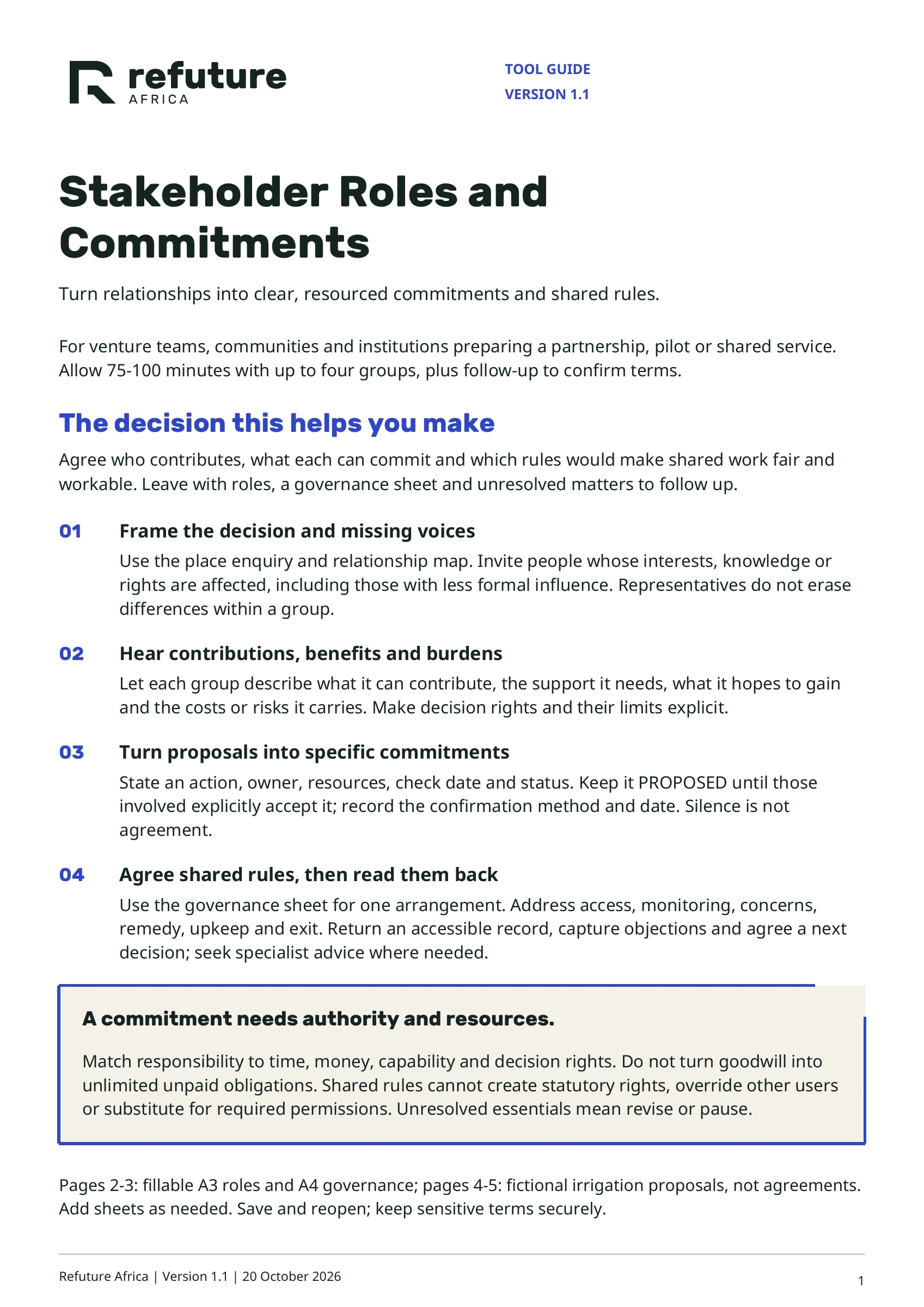
TOOL GUIDE
VERSION 1.1
Stakeholder Roles and
Commitments
Turn relationships into clear, resourced commitments and shared rules.
For venture teams, communities and institutions preparing a partnership, pilot or shared service.
Allow 75-100 minutes with up to four groups, plus follow-up to confirm terms.
The decision this helps you make
Agree who contributes, what each can commit and which rules would make shared work fair and
workable. Leave with roles, a governance sheet and unresolved matters to follow up.
01
Frame the decision and missing voices
Use the place enquiry and relationship map. Invite people whose interests, knowledge or
rights are affected, including those with less formal influence. Representatives do not erase
differences within a group.
02
Hear contributions, benefits and burdens
Let each group describe what it can contribute, the support it needs, what it hopes to gain
and the costs or risks it carries. Make decision rights and their limits explicit.
03
Turn proposals into specific commitments
State an action, owner, resources, check date and status. Keep it PROPOSED until those
involved explicitly accept it; record the confirmation method and date. Silence is not
agreement.
04
Agree shared rules, then read them back
Use the governance sheet for one arrangement. Address access, monitoring, concerns,
remedy, upkeep and exit. Return an accessible record, capture objections and agree a next
decision; seek specialist advice where needed.
A commitment needs authority and resources.
Match responsibility to time, money, capability and decision rights. Do not turn goodwill into
unlimited unpaid obligations. Shared rules cannot create statutory rights, override other users
or substitute for required permissions. Unresolved essentials mean revise or pause.
Pages 2-3: fillable A3 roles and A4 governance; pages 4-5: fictional irrigation proposals, not agreements.
Add sheets as needed. Save and reopen; keep sensitive terms securely.
Refuture Africa | Version 1.1 | 20 October 2026
1
Read page 2 as text
Text follows the PDF’s reading order; use the page image to see relationships and table columns.
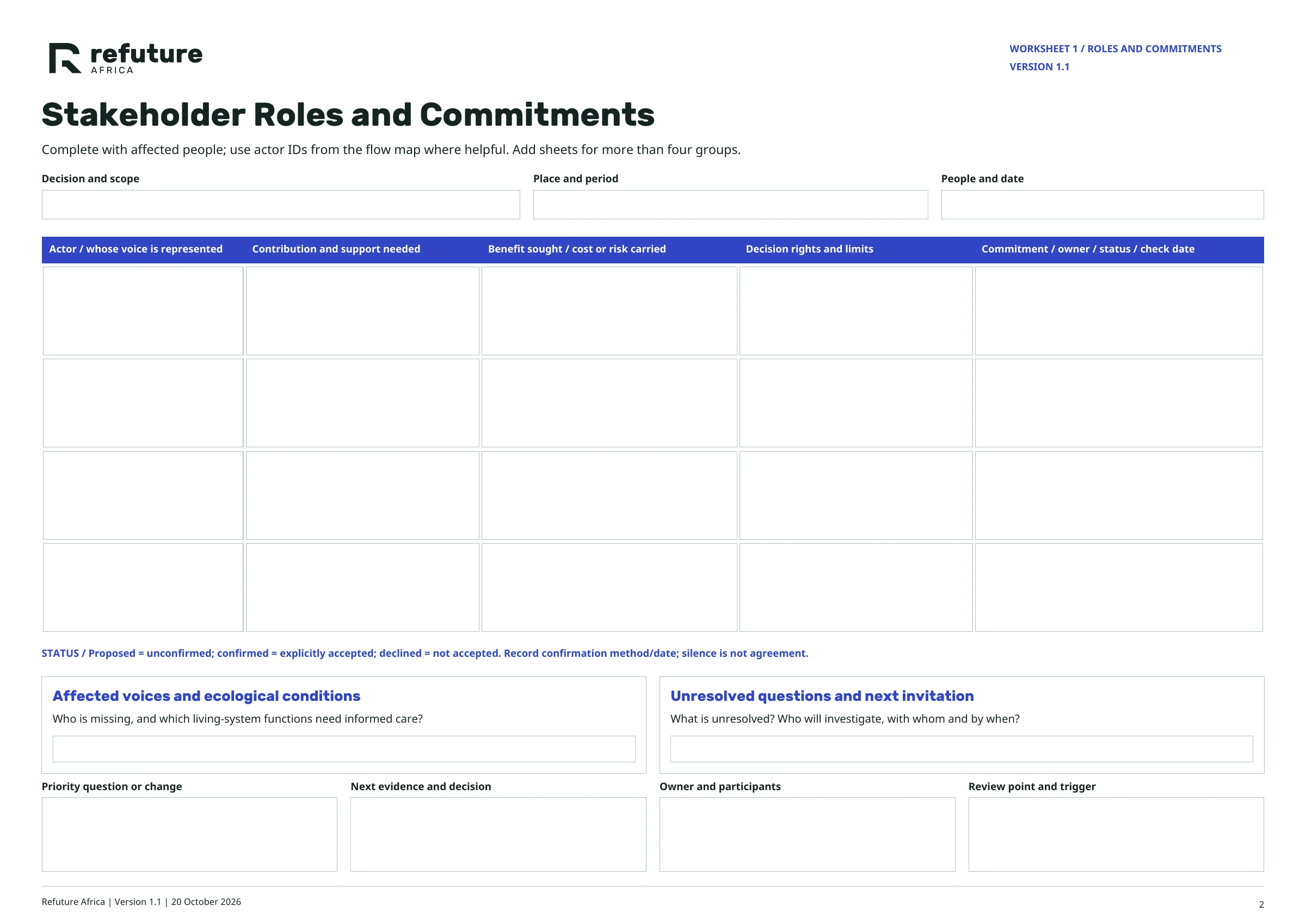
WORKSHEET 1 / ROLES AND COMMITMENTS
VERSION 1.1
Stakeholder Roles and Commitments
Complete with affected people; use actor IDs from the flow map where helpful. Add sheets for more than four groups.
Decision and scope
Place and period
People and date
Actor / whose voice is represented
Contribution and support needed
Benefit sought / cost or risk carried
Decision rights and limits
Commitment / owner / status / check date
STATUS / Proposed = unconfirmed; confirmed = explicitly accepted; declined = not accepted. Record confirmation method/date; silence is not agreement.
Affected voices and ecological conditions
Who is missing, and which living-system functions need informed care?
Unresolved questions and next invitation
What is unresolved? Who will investigate, with whom and by when?
Priority question or change
Next evidence and decision
Owner and participants
Review point and trigger
Refuture Africa | Version 1.1 | 20 October 2026
2
Read page 3 as text
Text follows the PDF’s reading order; use the page image to see relationships and table columns.
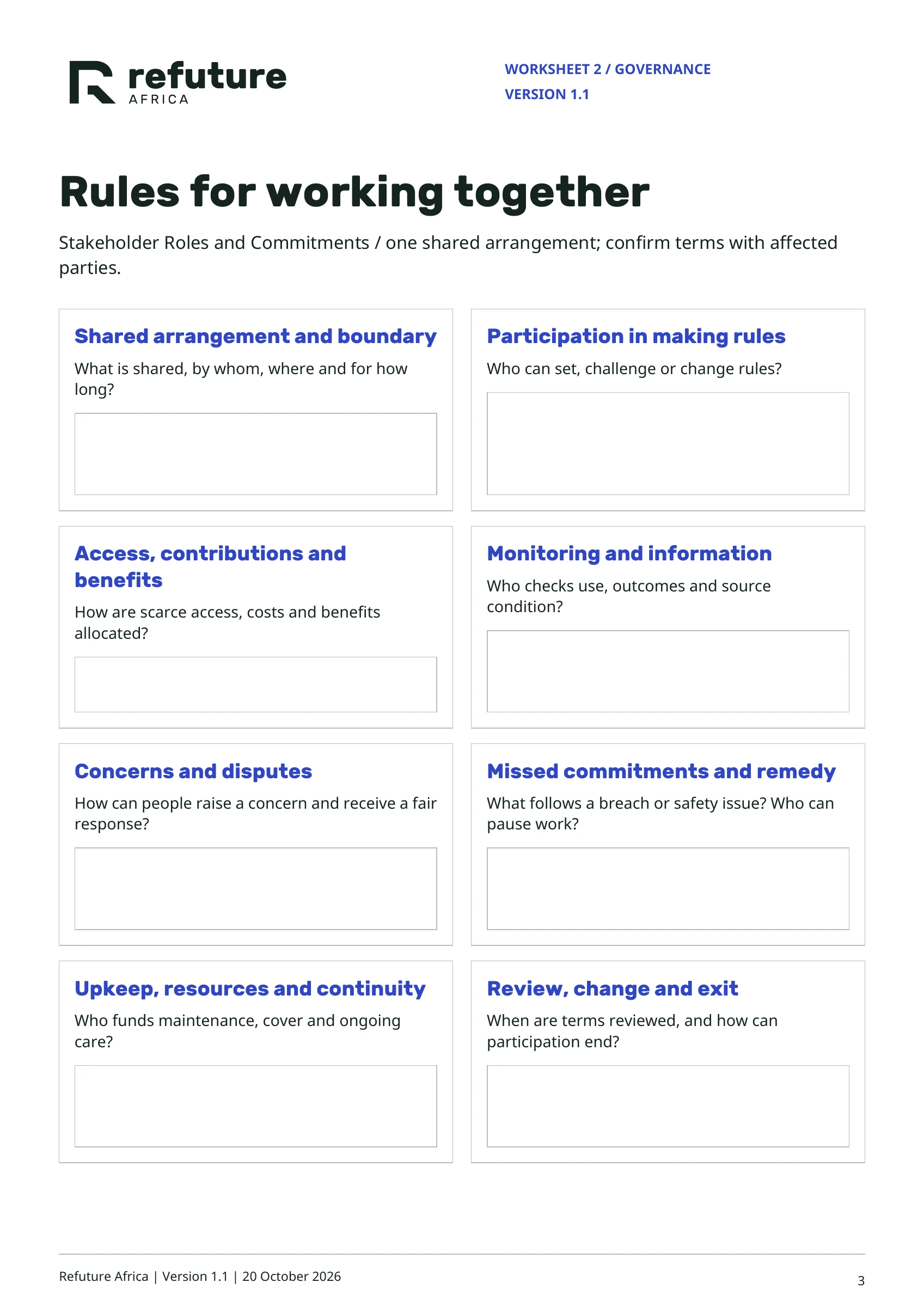
WORKSHEET 2 / GOVERNANCE
VERSION 1.1
Rules for working together
Stakeholder Roles and Commitments / one shared arrangement; confirm terms with affected
parties.
Shared arrangement and boundary
What is shared, by whom, where and for how
long?
Participation in making rules
Who can set, challenge or change rules?
Access, contributions and
benefits
How are scarce access, costs and benefits
allocated?
Monitoring and information
Who checks use, outcomes and source
condition?
Concerns and disputes
How can people raise a concern and receive a fair
response?
Missed commitments and remedy
What follows a breach or safety issue? Who can
pause work?
Upkeep, resources and continuity
Who funds maintenance, cover and ongoing
care?
Review, change and exit
When are terms reviewed, and how can
participation end?
Refuture Africa | Version 1.1 | 20 October 2026
3
Read page 4 as text
Text follows the PDF’s reading order; use the page image to see relationships and table columns.
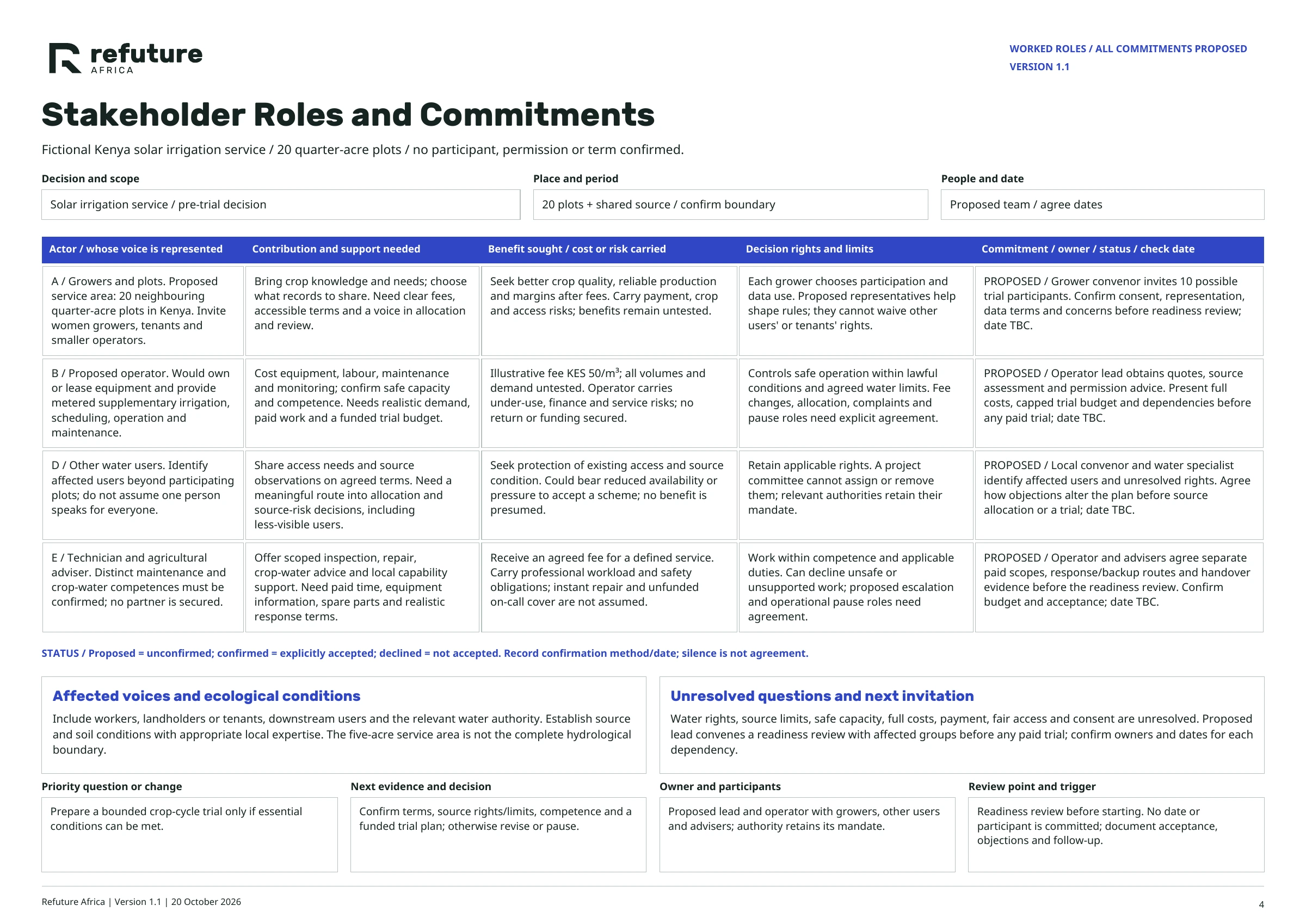
WORKED ROLES / ALL COMMITMENTS PROPOSED
VERSION 1.1
Stakeholder Roles and Commitments
Fictional Kenya solar irrigation service / 20 quarter-acre plots / no participant, permission or term confirmed.
Decision and scope
Solar irrigation service / pre-trial decision
Place and period
20 plots + shared source / confirm boundary
People and date
Proposed team / agree dates
Actor / whose voice is represented
Contribution and support needed
Benefit sought / cost or risk carried
Decision rights and limits
Commitment / owner / status / check date
A / Growers and plots. Proposed
service area: 20 neighbouring
quarter-acre plots in Kenya. Invite
women growers, tenants and
smaller operators.
Bring crop knowledge and needs; choose
what records to share. Need clear fees,
accessible terms and a voice in allocation
and review.
Seek better crop quality, reliable production
and margins after fees. Carry payment, crop
and access risks; benefits remain untested.
Each grower chooses participation and
data use. Proposed representatives help
shape rules; they cannot waive other
users' or tenants' rights.
PROPOSED / Grower convenor invites 10 possible
trial participants. Confirm consent, representation,
data terms and concerns before readiness review;
date TBC.
B / Proposed operator. Would own
or lease equipment and provide
metered supplementary irrigation,
scheduling, operation and
maintenance.
Cost equipment, labour, maintenance
and monitoring; confirm safe capacity
and competence. Needs realistic demand,
paid work and a funded trial budget.
Illustrative fee KES 50/m³; all volumes and
demand untested. Operator carries
under-use, finance and service risks; no
return or funding secured.
Controls safe operation within lawful
conditions and agreed water limits. Fee
changes, allocation, complaints and
pause roles need explicit agreement.
PROPOSED / Operator lead obtains quotes, source
assessment and permission advice. Present full
costs, capped trial budget and dependencies before
any paid trial; date TBC.
D / Other water users. Identify
affected users beyond participating
plots; do not assume one person
speaks for everyone.
Share access needs and source
observations on agreed terms. Need a
meaningful route into allocation and
source-risk decisions, including
less-visible users.
Seek protection of existing access and source
condition. Could bear reduced availability or
pressure to accept a scheme; no benefit is
presumed.
Retain applicable rights. A project
committee cannot assign or remove
them; relevant authorities retain their
mandate.
PROPOSED / Local convenor and water specialist
identify affected users and unresolved rights. Agree
how objections alter the plan before source
allocation or a trial; date TBC.
E / Technician and agricultural
adviser. Distinct maintenance and
crop-water competences must be
confirmed; no partner is secured.
Offer scoped inspection, repair,
crop-water advice and local capability
support. Need paid time, equipment
information, spare parts and realistic
response terms.
Receive an agreed fee for a defined service.
Carry professional workload and safety
obligations; instant repair and unfunded
on-call cover are not assumed.
Work within competence and applicable
duties. Can decline unsafe or
unsupported work; proposed escalation
and operational pause roles need
agreement.
PROPOSED / Operator and advisers agree separate
paid scopes, response/backup routes and handover
evidence before the readiness review. Confirm
budget and acceptance; date TBC.
STATUS / Proposed = unconfirmed; confirmed = explicitly accepted; declined = not accepted. Record confirmation method/date; silence is not agreement.
Affected voices and ecological conditions
Include workers, landholders or tenants, downstream users and the relevant water authority. Establish source
and soil conditions with appropriate local expertise. The five-acre service area is not the complete hydrological
boundary.
Unresolved questions and next invitation
Water rights, source limits, safe capacity, full costs, payment, fair access and consent are unresolved. Proposed
lead convenes a readiness review with affected groups before any paid trial; confirm owners and dates for each
dependency.
Priority question or change
Prepare a bounded crop-cycle trial only if essential
conditions can be met.
Next evidence and decision
Confirm terms, source rights/limits, competence and a
funded trial plan; otherwise revise or pause.
Owner and participants
Proposed lead and operator with growers, other users
and advisers; authority retains its mandate.
Review point and trigger
Readiness review before starting. No date or
participant is committed; document acceptance,
objections and follow-up.
Refuture Africa | Version 1.1 | 20 October 2026
4
Read page 5 as text
Text follows the PDF’s reading order; use the page image to see relationships and table columns.
WORKED RULES / PROPOSALS, NOT AN AGREEMENT
VERSION 1.1
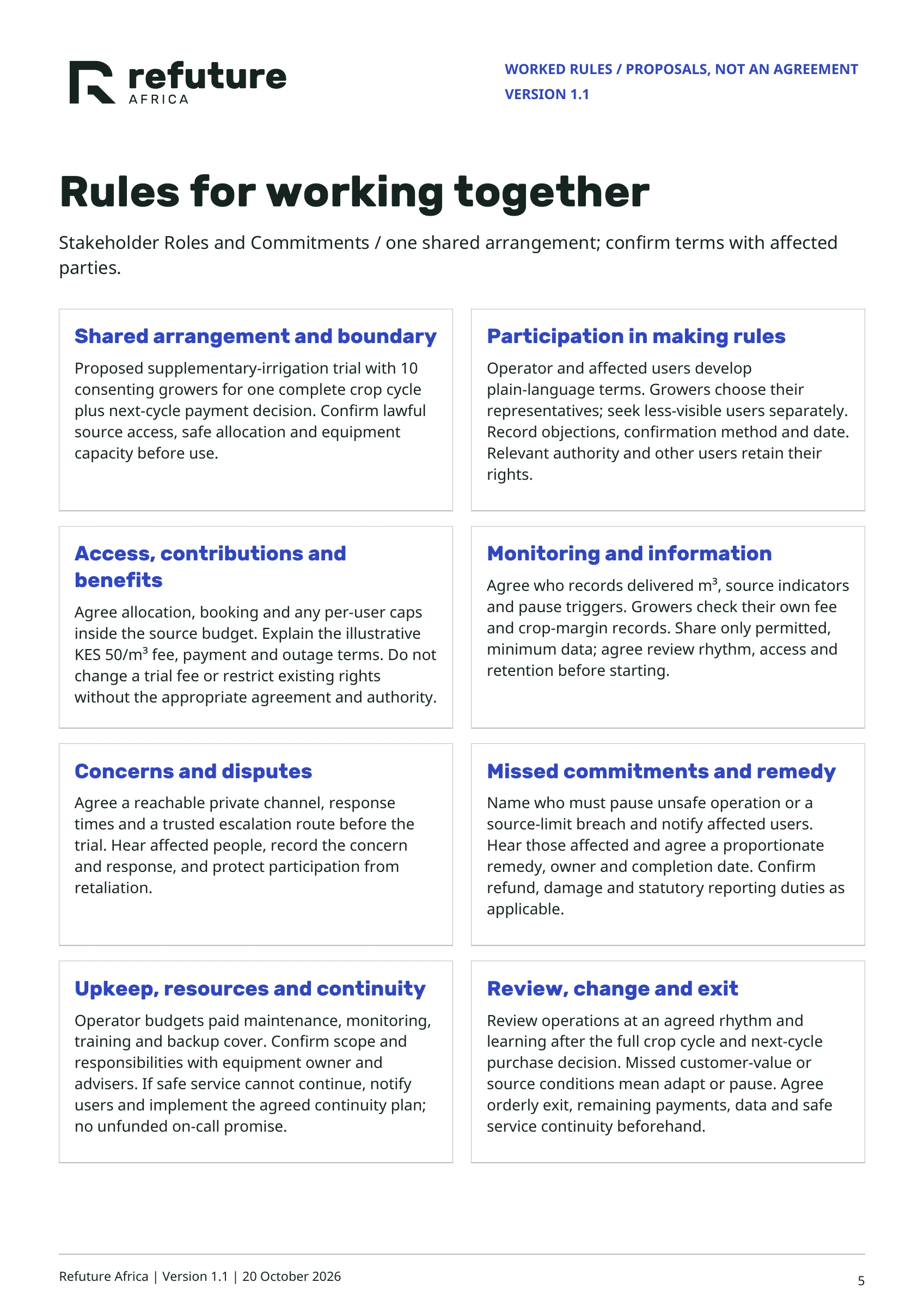
Rules for working together
Stakeholder Roles and Commitments / one shared arrangement; confirm terms with affected
parties.
Shared arrangement and boundary
Proposed supplementary-irrigation trial with 10
consenting growers for one complete crop cycle
plus next-cycle payment decision. Confirm lawful
source access, safe allocation and equipment
capacity before use.
Participation in making rules
Operator and affected users develop
plain-language terms. Growers choose their
representatives; seek less-visible users separately.
Record objections, confirmation method and date.
Relevant authority and other users retain their
rights.
Access, contributions and
benefits
Agree allocation, booking and any per-user caps
inside the source budget. Explain the illustrative
KES 50/m³ fee, payment and outage terms. Do not
change a trial fee or restrict existing rights
without the appropriate agreement and authority.
Monitoring and information
Agree who records delivered m³, source indicators
and pause triggers. Growers check their own fee
and crop-margin records. Share only permitted,
minimum data; agree review rhythm, access and
retention before starting.
Concerns and disputes
Agree a reachable private channel, response
times and a trusted escalation route before the
trial. Hear affected people, record the concern
and response, and protect participation from
retaliation.
Missed commitments and remedy
Name who must pause unsafe operation or a
source-limit breach and notify affected users.
Hear those affected and agree a proportionate
remedy, owner and completion date. Confirm
refund, damage and statutory reporting duties as
applicable.
Upkeep, resources and continuity
Operator budgets paid maintenance, monitoring,
training and backup cover. Confirm scope and
responsibilities with equipment owner and
advisers. If safe service cannot continue, notify
users and implement the agreed continuity plan;
no unfunded on-call promise.
Review, change and exit
Review operations at an agreed rhythm and
learning after the full crop cycle and next-cycle
purchase decision. Missed customer-value or
source conditions mean adapt or pause. Agree
orderly exit, remaining payments, data and safe
service continuity beforehand.
Refuture Africa | Version 1.1 | 20 October 2026
5
Read page 6 as text
Text follows the PDF’s reading order; use the page image to see relationships and table columns.
REVIEW, EVIDENCE AND USE
VERSION 1.1
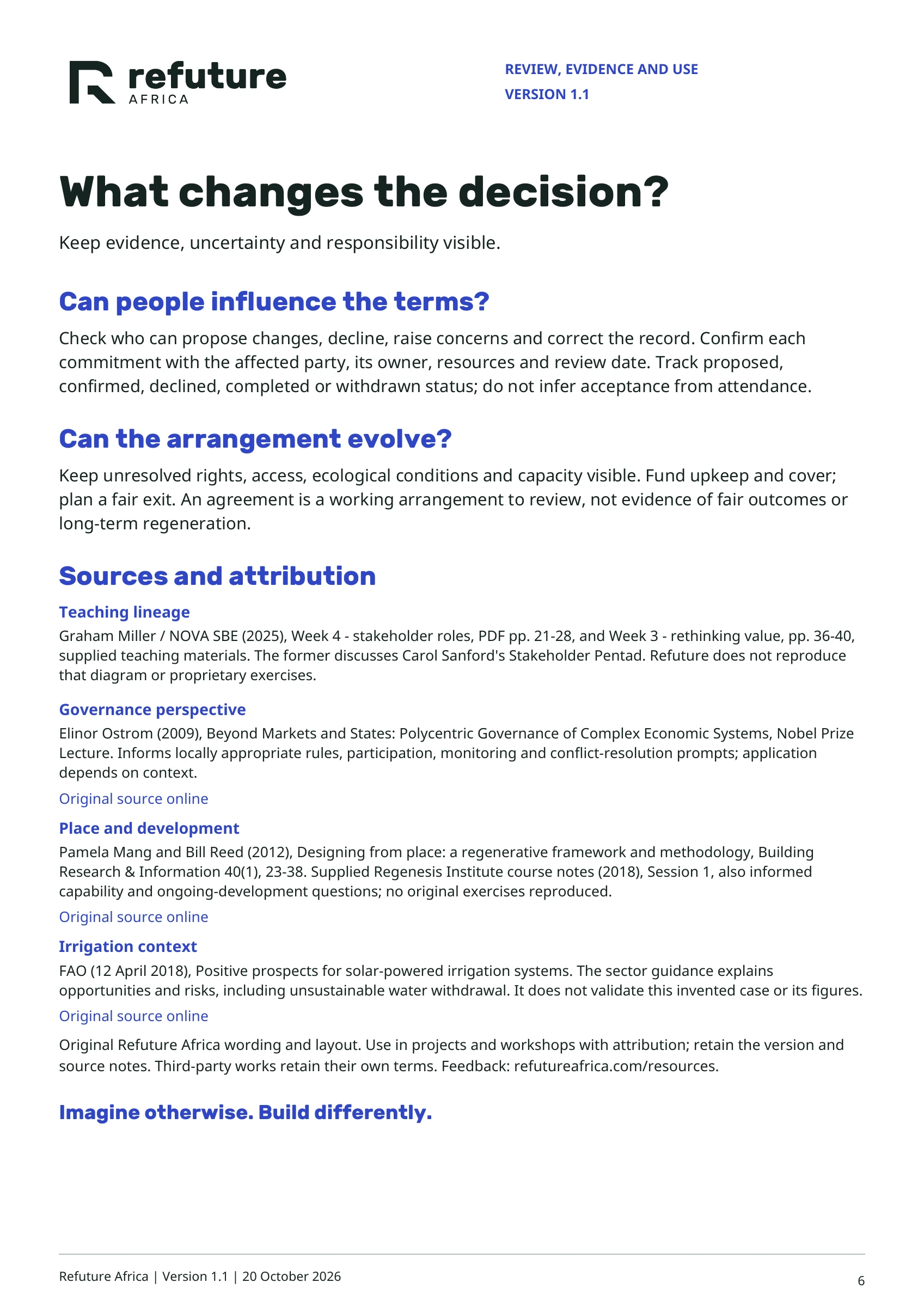
What changes the decision?
Keep evidence, uncertainty and responsibility visible.
Can people influence the terms?
Check who can propose changes, decline, raise concerns and correct the record. Confirm each
commitment with the affected party, its owner, resources and review date. Track proposed,
confirmed, declined, completed or withdrawn status; do not infer acceptance from attendance.
Can the arrangement evolve?
Keep unresolved rights, access, ecological conditions and capacity visible. Fund upkeep and cover;
plan a fair exit. An agreement is a working arrangement to review, not evidence of fair outcomes or
long-term regeneration.
Sources and attribution
Teaching lineage
Graham Miller / NOVA SBE (2025), Week 4 - stakeholder roles, PDF pp. 21-28, and Week 3 - rethinking value, pp. 36-40,
supplied teaching materials. The former discusses Carol Sanford's Stakeholder Pentad. Refuture does not reproduce
that diagram or proprietary exercises.
Governance perspective
Elinor Ostrom (2009), Beyond Markets and States: Polycentric Governance of Complex Economic Systems, Nobel Prize
Lecture. Informs locally appropriate rules, participation, monitoring and conflict-resolution prompts; application
depends on context.
Original source online
Place and development
Pamela Mang and Bill Reed (2012), Designing from place: a regenerative framework and methodology, Building
Research & Information 40(1), 23-38. Supplied Regenesis Institute course notes (2018), Session 1, also informed
capability and ongoing-development questions; no original exercises reproduced.
Original source online
Irrigation context
FAO (12 April 2018), Positive prospects for solar-powered irrigation systems. The sector guidance explains
opportunities and risks, including unsustainable water withdrawal. It does not validate this invented case or its figures.
Original source online
Original Refuture Africa wording and layout. Use in projects and workshops with attribution; retain the version and
source notes. Third-party works retain their own terms. Feedback: refutureafrica.com/resources.
Imagine otherwise. Build differently.
Refuture Africa | Version 1.1 | 20 October 2026
6