Read page 1 as text
Text follows the PDF’s reading order; use the page image to see relationships and table columns.
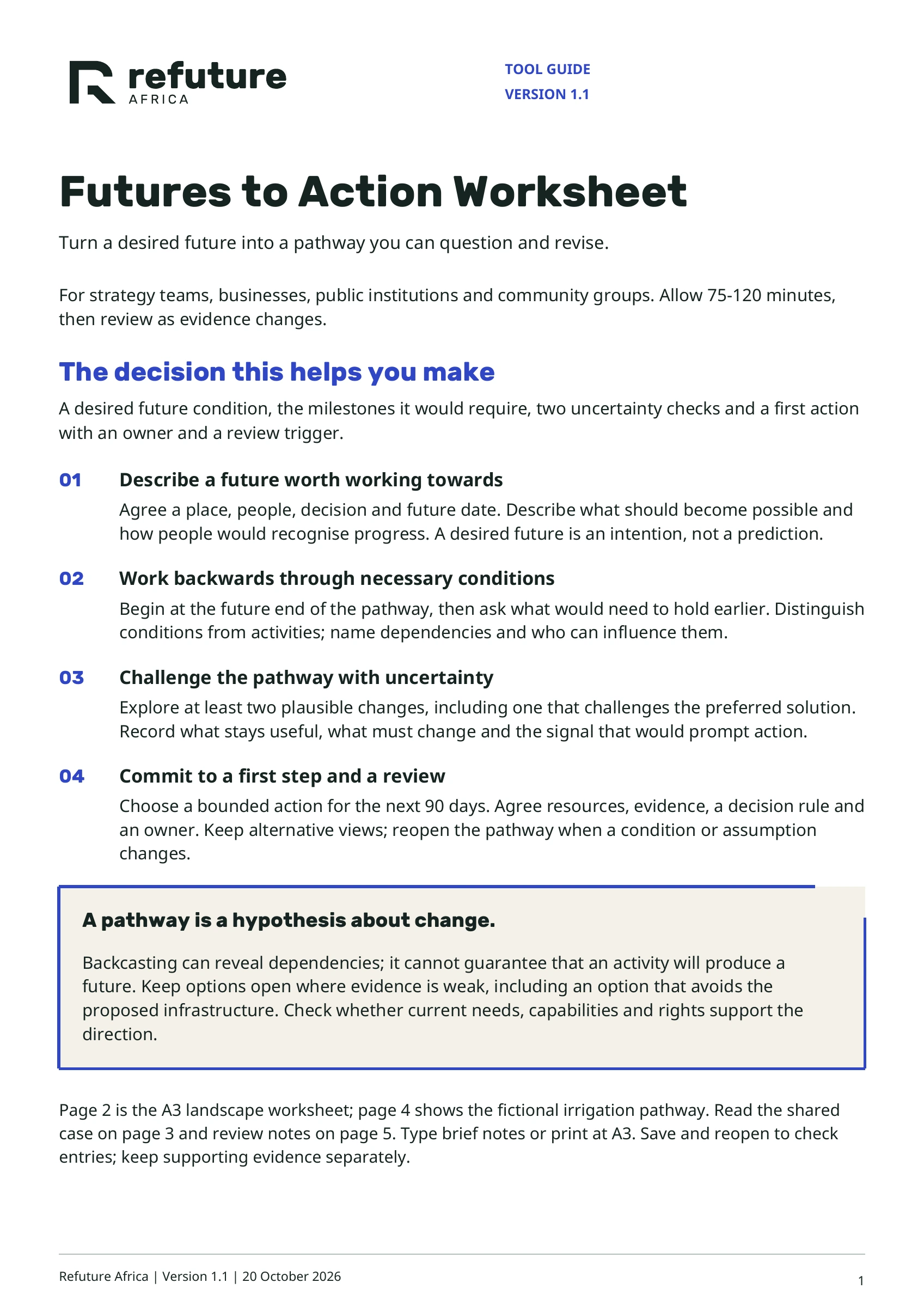
TOOL GUIDE
VERSION 1.1
Futures to Action Worksheet
Turn a desired future into a pathway you can question and revise.
For strategy teams, businesses, public institutions and community groups. Allow 75-120 minutes,
then review as evidence changes.
The decision this helps you make
A desired future condition, the milestones it would require, two uncertainty checks and a first action
with an owner and a review trigger.
01
Describe a future worth working towards
Agree a place, people, decision and future date. Describe what should become possible and
how people would recognise progress. A desired future is an intention, not a prediction.
02
Work backwards through necessary conditions
Begin at the future end of the pathway, then ask what would need to hold earlier. Distinguish
conditions from activities; name dependencies and who can influence them.
03
Challenge the pathway with uncertainty
Explore at least two plausible changes, including one that challenges the preferred solution.
Record what stays useful, what must change and the signal that would prompt action.
04
Commit to a first step and a review
Choose a bounded action for the next 90 days. Agree resources, evidence, a decision rule and
an owner. Keep alternative views; reopen the pathway when a condition or assumption
changes.
A pathway is a hypothesis about change.
Backcasting can reveal dependencies; it cannot guarantee that an activity will produce a
future. Keep options open where evidence is weak, including an option that avoids the
proposed infrastructure. Check whether current needs, capabilities and rights support the
direction.
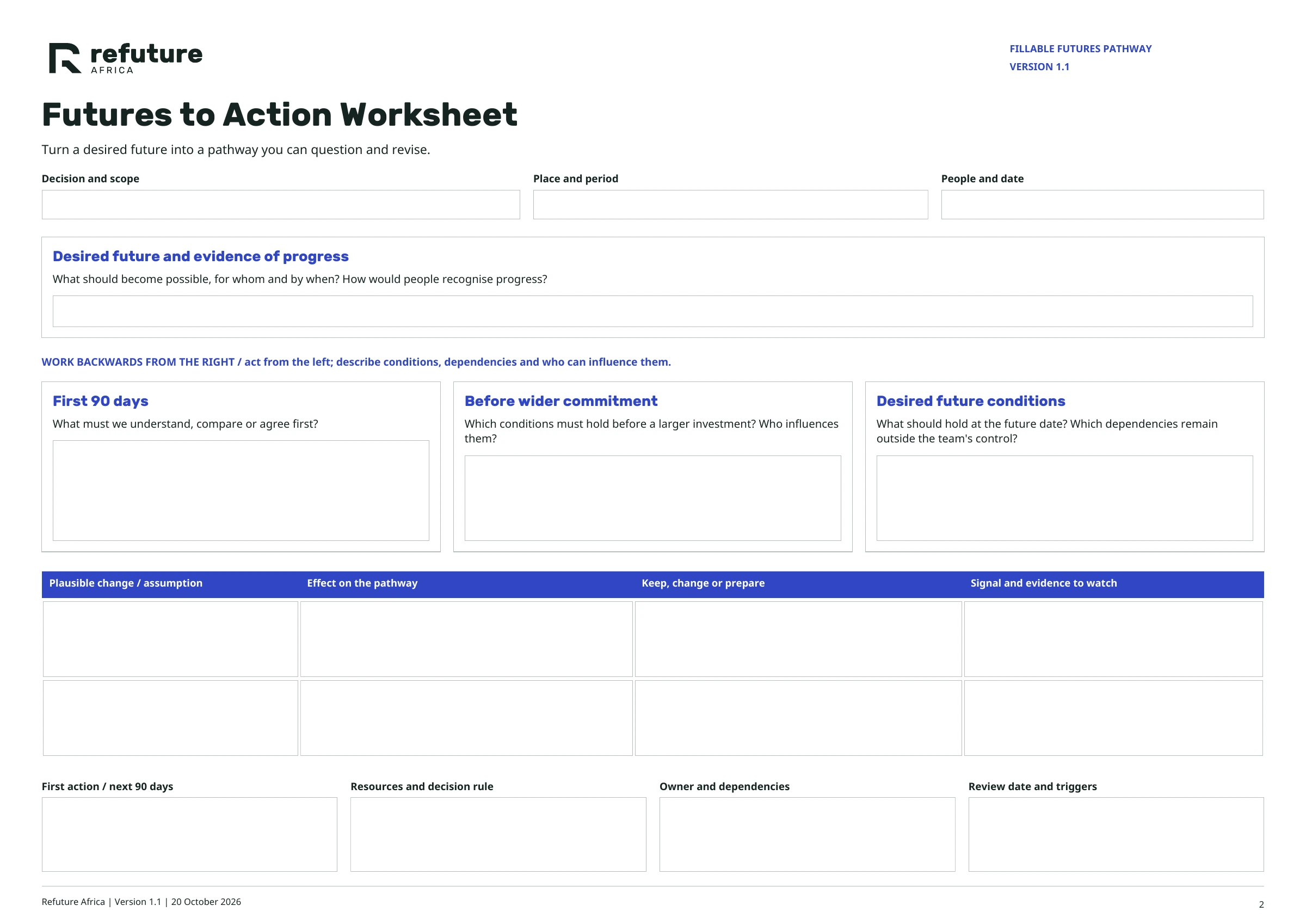
Page 2 is the A3 landscape worksheet; page 4 shows the fictional irrigation pathway. Read the shared
case on page 3 and review notes on page 5. Type brief notes or print at A3. Save and reopen to check
entries; keep supporting evidence separately.
Refuture Africa | Version 1.1 | 20 October 2026
1
Read page 2 as text
Text follows the PDF’s reading order; use the page image to see relationships and table columns.
FILLABLE FUTURES PATHWAY
VERSION 1.1
Futures to Action Worksheet
Turn a desired future into a pathway you can question and revise.
Decision and scope
Place and period
People and date
Desired future and evidence of progress
What should become possible, for whom and by when? How would people recognise progress?
WORK BACKWARDS FROM THE RIGHT / act from the left; describe conditions, dependencies and who can influence them.
First 90 days
What must we understand, compare or agree first?
Before wider commitment
Which conditions must hold before a larger investment? Who influences
them?
Desired future conditions
What should hold at the future date? Which dependencies remain
outside the team's control?
Plausible change / assumption
Effect on the pathway
Keep, change or prepare
Signal and evidence to watch
First action / next 90 days
Resources and decision rule
Owner and dependencies
Review date and triggers
Refuture Africa | Version 1.1 | 20 October 2026
2
Read page 3 as text
Text follows the PDF’s reading order; use the page image to see relationships and table columns.
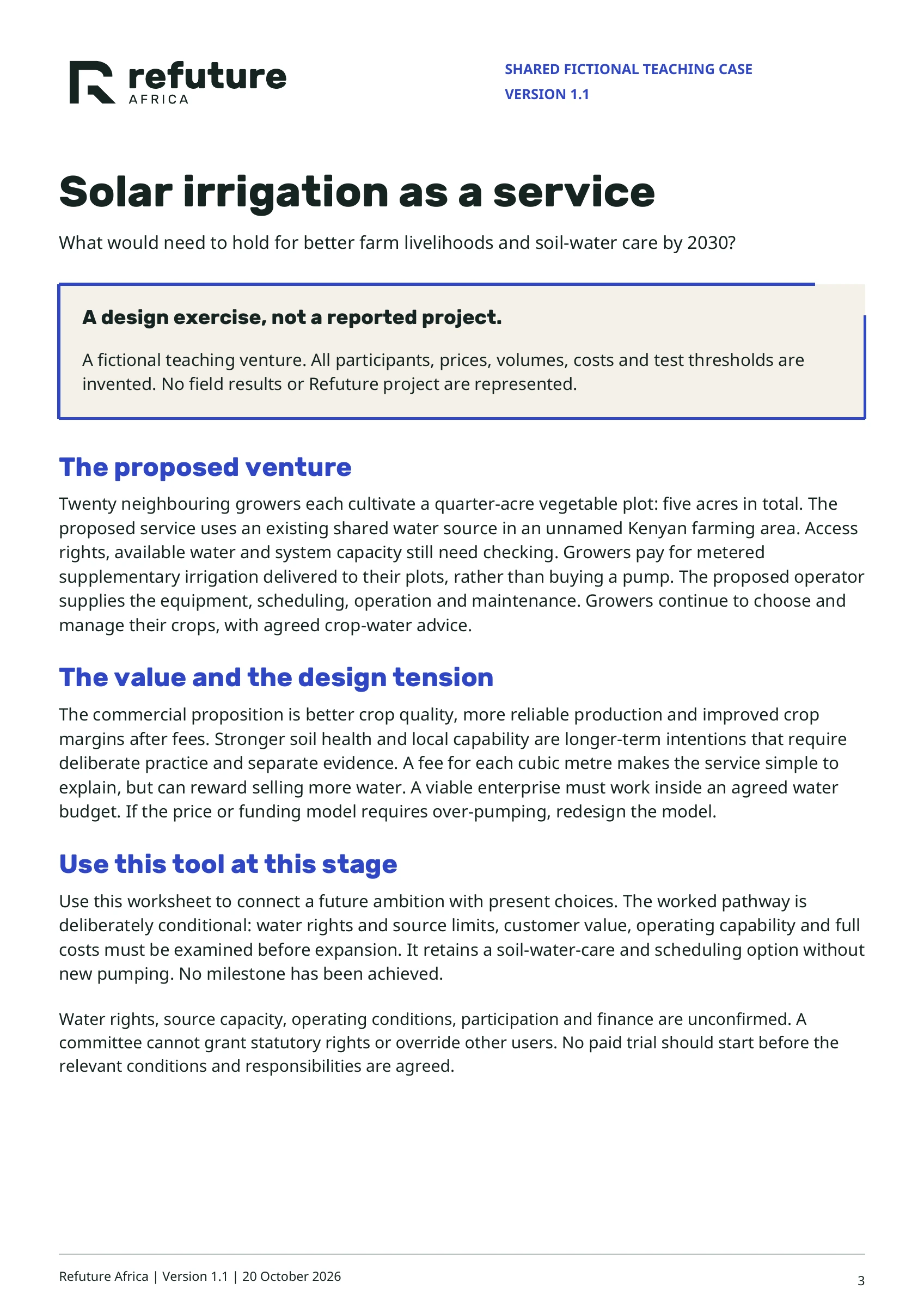
SHARED FICTIONAL TEACHING CASE
VERSION 1.1
Solar irrigation as a service
What would need to hold for better farm livelihoods and soil-water care by 2030?
A design exercise, not a reported project.
A fictional teaching venture. All participants, prices, volumes, costs and test thresholds are
invented. No field results or Refuture project are represented.
The proposed venture
Twenty neighbouring growers each cultivate a quarter-acre vegetable plot: five acres in total. The
proposed service uses an existing shared water source in an unnamed Kenyan farming area. Access
rights, available water and system capacity still need checking. Growers pay for metered
supplementary irrigation delivered to their plots, rather than buying a pump. The proposed operator
supplies the equipment, scheduling, operation and maintenance. Growers continue to choose and
manage their crops, with agreed crop-water advice.
The value and the design tension
The commercial proposition is better crop quality, more reliable production and improved crop
margins after fees. Stronger soil health and local capability are longer-term intentions that require
deliberate practice and separate evidence. A fee for each cubic metre makes the service simple to
explain, but can reward selling more water. A viable enterprise must work inside an agreed water
budget. If the price or funding model requires over-pumping, redesign the model.
Use this tool at this stage
Use this worksheet to connect a future ambition with present choices. The worked pathway is
deliberately conditional: water rights and source limits, customer value, operating capability and full
costs must be examined before expansion. It retains a soil-water-care and scheduling option without
new pumping. No milestone has been achieved.
Water rights, source capacity, operating conditions, participation and finance are unconfirmed. A
committee cannot grant statutory rights or override other users. No paid trial should start before the
relevant conditions and responsibilities are agreed.
Refuture Africa | Version 1.1 | 20 October 2026
3
Read page 4 as text
Text follows the PDF’s reading order; use the page image to see relationships and table columns.
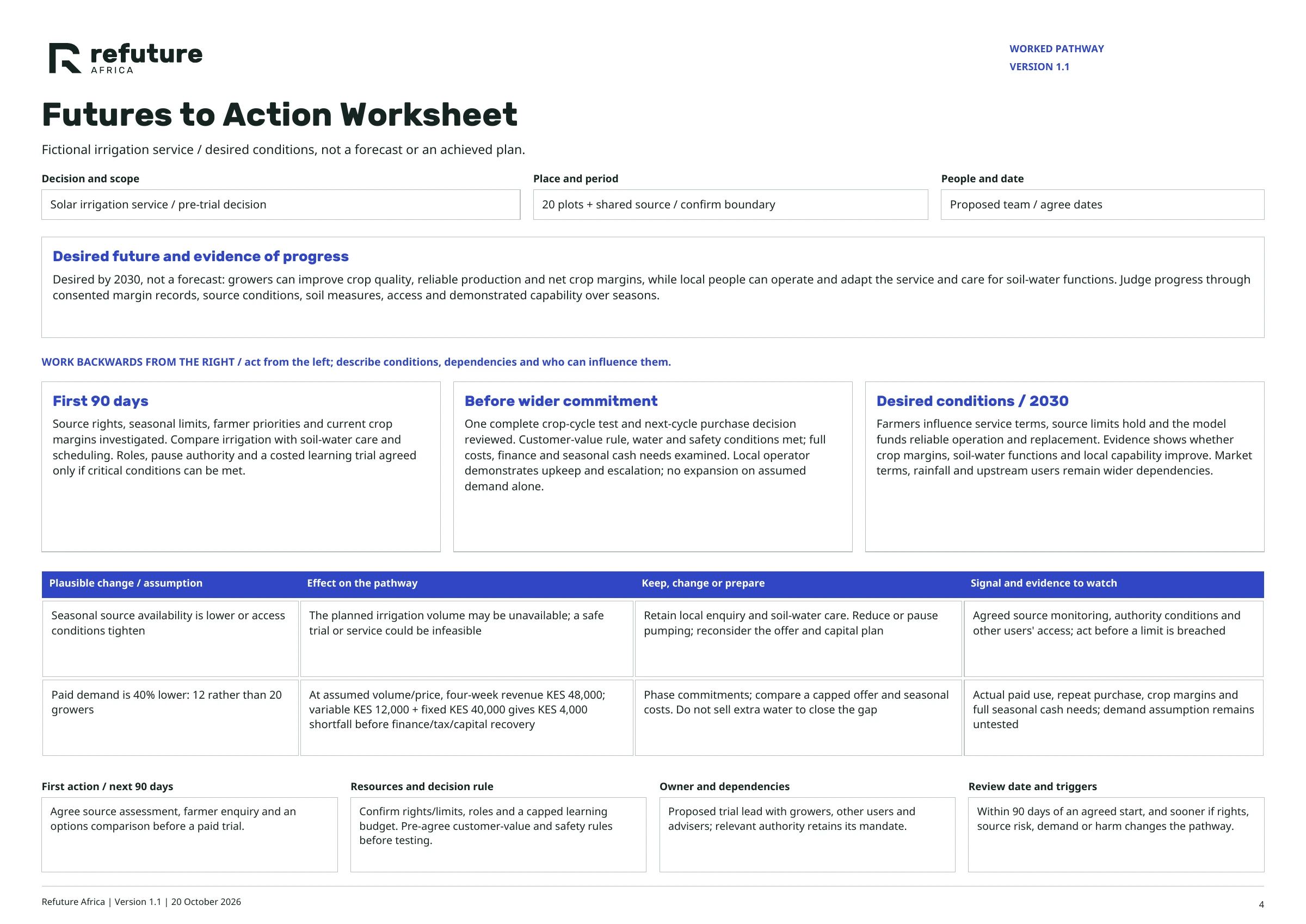
WORKED PATHWAY
VERSION 1.1
Futures to Action Worksheet
Fictional irrigation service / desired conditions, not a forecast or an achieved plan.
Decision and scope
Solar irrigation service / pre-trial decision
Place and period
20 plots + shared source / confirm boundary
People and date
Proposed team / agree dates
Desired future and evidence of progress
Desired by 2030, not a forecast: growers can improve crop quality, reliable production and net crop margins, while local people can operate and adapt the service and care for soil-water functions. Judge progress through
consented margin records, source conditions, soil measures, access and demonstrated capability over seasons.
WORK BACKWARDS FROM THE RIGHT / act from the left; describe conditions, dependencies and who can influence them.
First 90 days
Source rights, seasonal limits, farmer priorities and current crop
margins investigated. Compare irrigation with soil-water care and
scheduling. Roles, pause authority and a costed learning trial agreed
only if critical conditions can be met.
Before wider commitment
One complete crop-cycle test and next-cycle purchase decision
reviewed. Customer-value rule, water and safety conditions met; full
costs, finance and seasonal cash needs examined. Local operator
demonstrates upkeep and escalation; no expansion on assumed
demand alone.
Desired conditions / 2030
Farmers influence service terms, source limits hold and the model
funds reliable operation and replacement. Evidence shows whether
crop margins, soil-water functions and local capability improve. Market
terms, rainfall and upstream users remain wider dependencies.
Plausible change / assumption
Effect on the pathway
Keep, change or prepare
Signal and evidence to watch
Seasonal source availability is lower or access
conditions tighten
The planned irrigation volume may be unavailable; a safe
trial or service could be infeasible
Retain local enquiry and soil-water care. Reduce or pause
pumping; reconsider the offer and capital plan
Agreed source monitoring, authority conditions and
other users' access; act before a limit is breached
Paid demand is 40% lower: 12 rather than 20
growers
At assumed volume/price, four-week revenue KES 48,000;
variable KES 12,000 + fixed KES 40,000 gives KES 4,000
shortfall before finance/tax/capital recovery
Phase commitments; compare a capped offer and seasonal
costs. Do not sell extra water to close the gap
Actual paid use, repeat purchase, crop margins and
full seasonal cash needs; demand assumption remains
untested
First action / next 90 days
Agree source assessment, farmer enquiry and an
options comparison before a paid trial.
Resources and decision rule
Confirm rights/limits, roles and a capped learning
budget. Pre-agree customer-value and safety rules
before testing.
Owner and dependencies
Proposed trial lead with growers, other users and
advisers; relevant authority retains its mandate.
Review date and triggers
Within 90 days of an agreed start, and sooner if rights,
source risk, demand or harm changes the pathway.
Refuture Africa | Version 1.1 | 20 October 2026
4
Read page 5 as text
Text follows the PDF’s reading order; use the page image to see relationships and table columns.
REVIEW, EVIDENCE AND USE
VERSION 1.1
What changes the decision?
Keep evidence, uncertainty and responsibility visible.
Use consistent units and time periods
In this case, KES 50/m³ and 80 m³/grower per four weeks are invented budget assumptions. They are
not a crop-water recommendation or a crop-cycle duration. The 20-grower model and a 10-grower
learning trial answer different questions.
Keep learning rules and futures distinct
The illustrative crop-cycle trial tests at least 10% median paired crop-margin gain after all costs/fees
AND 8/10 paying again, with water and safety limits met. Use positive comparison margins or
pre-agree an absolute KES gain. Passing one trial does not demonstrate the desired 2030 future or
long-term regeneration.
Sources and attribution
Futures methods
UK Government Office for Science, Futures Toolkit and associated worksheets (2024): visioning, backcasting,
stress-testing and roadmapping. Refuture uses original wording and layout.
Original source online
Research connection
Isaac Jumba (2026), Designing for Regeneration: A Venture Studio Model to Build Regenerative Ventures in Africa,
appendices I and X: potential, place and capability building over time.
Irrigation context
FAO (12 April 2018), Positive prospects for solar-powered irrigation systems. The sector guidance explains
opportunities and risks, including unsustainable water withdrawal. It does not validate this invented case or its figures.
Original source online
Original Refuture Africa wording and layout. Use in projects and workshops with attribution; retain the version and
source notes. Third-party works retain their own terms. Feedback: refutureafrica.com/resources.
Imagine otherwise. Build differently.
Refuture Africa | Version 1.1 | 20 October 2026
5