← All tools

Refuture Africa / Online preview / Version 1.1

Experiment and Learning Card

Agree a test and evidence threshold, then record the result, its limits and the decision that follows.

Read all 7 pages below, including the guide, worksheets and examples. This preview is read-only. To complete the worksheets, download the fillable PDF with your name and email.

On a small screen, open a full-size page to zoom, or expand its text view. The PDFs are not fully tagged for screen readers. Use the online text view if it works better with your assistive technology.

Worked examples use a fictional solar irrigation service. Assumptions, proposals and simulated results are labelled in the tools.

Facilitator guide: prepare and run a session

Prepare

For founders, project teams and institutions testing an offer, service or intervention. Allow 30-45 min to plan + review. Invite people affected by the decision and people who can explain how delivery, money and decision rights work. Agree consent, attribution and how disagreements will be recorded.

Bring relevant evidence with sources and dates, a printed worksheet or a PDF editor, and a way to record unresolved questions. Read the teaching example beforehand; its invented figures are not benchmarks.

Run the session

  1. Name one assumption and the decision at stake

    State what would need to be true, why it matters and what existing evidence supports or challenges it. Test an uncertainty that could change a real decision.

  2. Choose a useful, fair test

    Agree participants, informed participation, a comparison and responsibilities. Specify withdrawal, harm and pause conditions. Check that resources and authority exist before starting.

  3. Set measures and the rule beforehand

    State units, period, baseline, threshold and the combined rule for continuing or changing. Include full costs, harms and missing data; do not lower the threshold after seeing results.

  4. Record results, then make a bounded decision

    Complete the learning record afterwards. Compare evidence with the original rule, examine other explanations and choose continue, adapt, stop or gather more evidence. Assign the next owner and review.

Check the quality

It does not validate an entire business, establish causation by itself or prove long-term regeneration. A worksheet is not a substitute for specialist design and oversight where a test could create serious harm. Respect withdrawal, confidentiality and the rights of people outside the test.

Separate what is known, assumed and still to explore. Invite a different view before agreeing the next action. A proposed commitment stays a proposal until the responsible people confirm it.

Close and follow through

Read back the decision, evidence gaps, owner, resources and review date. Record what would make the team pause or change course. Share the record with participants and confirm corrections.

Use the worksheet

Pages 2-3 separate planning from learning. Pages 5-6 show a fictional plan and clearly simulated learning; no field results are reported. Print at A4 or type brief notes, then save and reopen. Keep consented data securely outside the shareable worksheet.

Experiment and Learning Card — page 1: Tool guide
Read page 1 as text

Text follows the PDF’s reading order; use the page image to see relationships and table columns.

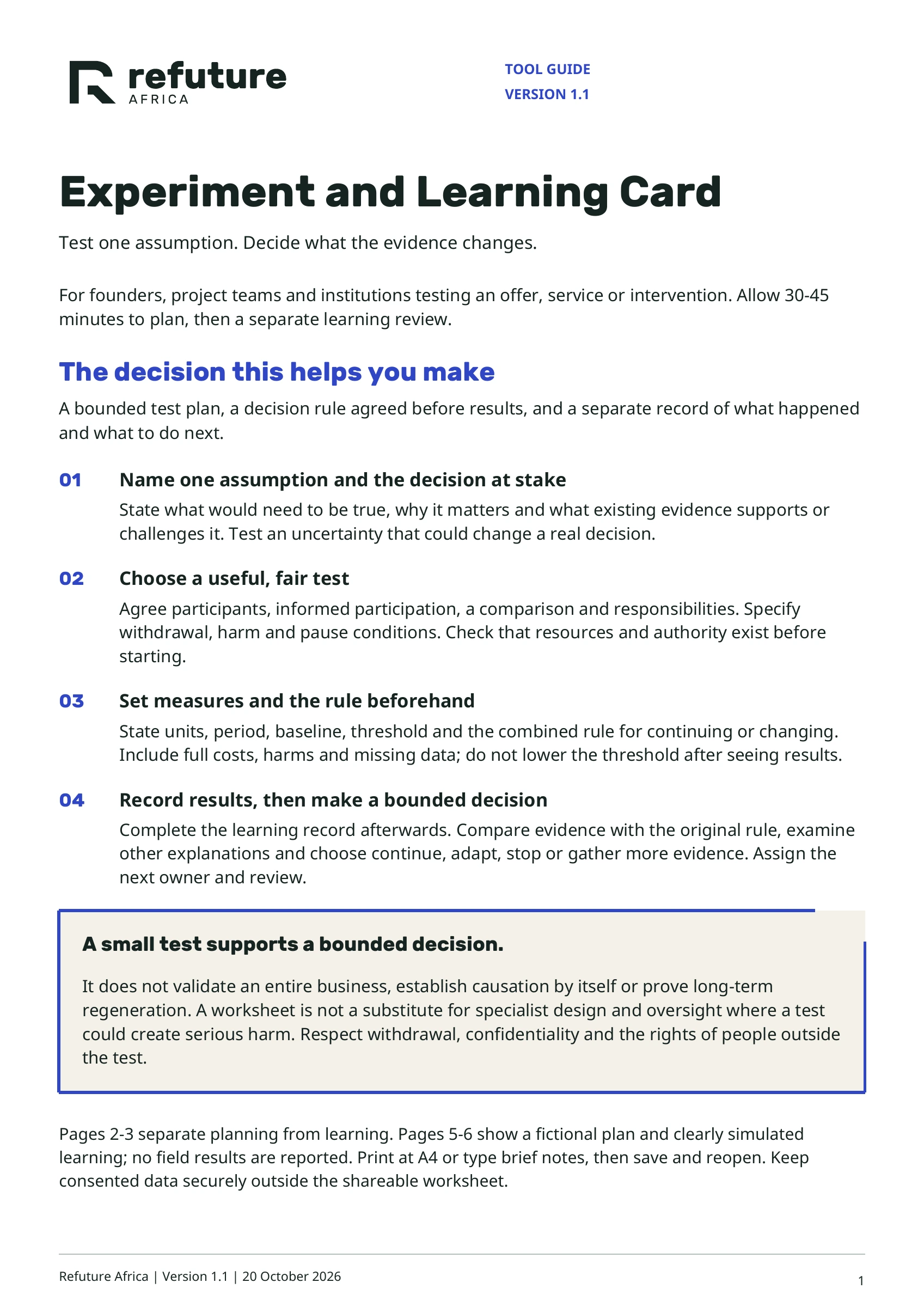
TOOL GUIDE VERSION 1.1 Experiment and Learning Card Test one assumption. Decide what the evidence changes. For founders, project teams and institutions testing an offer, service or intervention. Allow 30-45 minutes to plan, then a separate learning review. The decision this helps you make A bounded test plan, a decision rule agreed before results, and a separate record of what happened and what to do next. 01 Name one assumption and the decision at stake State what would need to be true, why it matters and what existing evidence supports or challenges it. Test an uncertainty that could change a real decision. 02 Choose a useful, fair test Agree participants, informed participation, a comparison and responsibilities. Specify withdrawal, harm and pause conditions. Check that resources and authority exist before starting. 03 Set measures and the rule beforehand State units, period, baseline, threshold and the combined rule for continuing or changing. Include full costs, harms and missing data; do not lower the threshold after seeing results. 04 Record results, then make a bounded decision Complete the learning record afterwards. Compare evidence with the original rule, examine other explanations and choose continue, adapt, stop or gather more evidence. Assign the next owner and review. A small test supports a bounded decision. It does not validate an entire business, establish causation by itself or prove long-term regeneration. A worksheet is not a substitute for specialist design and oversight where a test could create serious harm. Respect withdrawal, confidentiality and the rights of people outside the test. Pages 2-3 separate planning from learning. Pages 5-6 show a fictional plan and clearly simulated learning; no field results are reported. Print at A4 or type brief notes, then save and reopen. Keep consented data securely outside the shareable worksheet. Refuture Africa | Version 1.1 | 20 October 2026 1

2 / Experiment plan / complete before testing

Open full-size page 2 in a new tab ↗
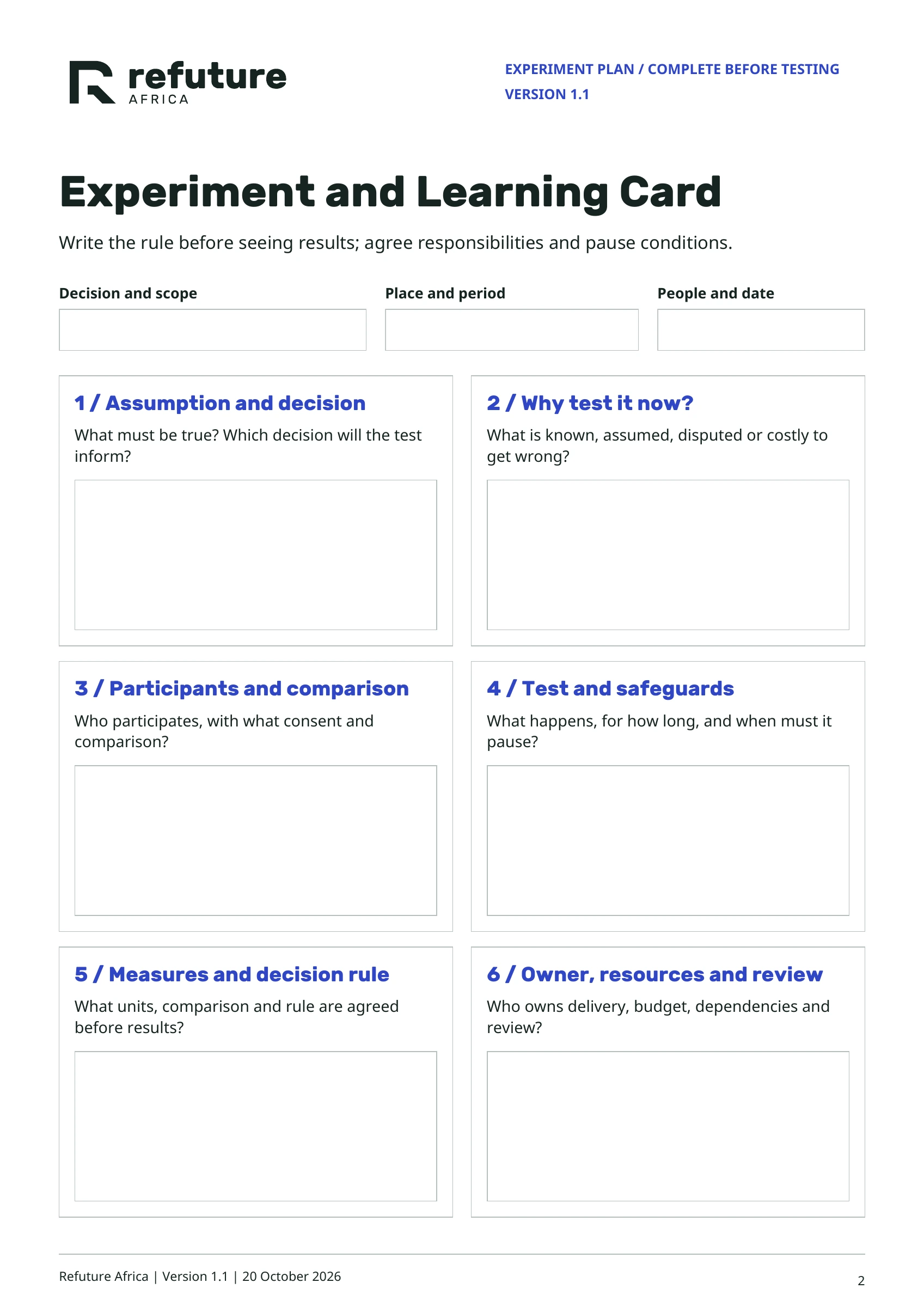
Experiment and Learning Card — page 2: Experiment plan / complete before testing
Read page 2 as text

Text follows the PDF’s reading order; use the page image to see relationships and table columns.

Worksheet entry labels

These labels identify the blank fields in this worksheet. Repeated row labels belong to separate entries.

  1. Decision and scope
  2. Place and period
  3. People and date
  4. 1 / Assumption and decision. What must be true? Which decision will the test inform?
  5. 2 / Why test it now?. What is known, assumed, disputed or costly to get wrong?
  6. 3 / Participants and comparison. Who participates, with what consent and comparison?
  7. 4 / Test and safeguards. What happens, for how long, and when must it pause?
  8. 5 / Measures and decision rule. What units, comparison and rule are agreed before results?
  9. 6 / Owner, resources and review. Who owns delivery, budget, dependencies and review?
EXPERIMENT PLAN / COMPLETE BEFORE TESTING VERSION 1.1 Experiment and Learning Card Write the rule before seeing results; agree responsibilities and pause conditions. Decision and scope Place and period People and date 1 / Assumption and decision What must be true? Which decision will the test inform? 2 / Why test it now? What is known, assumed, disputed or costly to get wrong? 3 / Participants and comparison Who participates, with what consent and comparison? 4 / Test and safeguards What happens, for how long, and when must it pause? 5 / Measures and decision rule What units, comparison and rule are agreed before results? 6 / Owner, resources and review Who owns delivery, budget, dependencies and review? Refuture Africa | Version 1.1 | 20 October 2026 2

3 / Learning record / complete after testing

Open full-size page 3 in a new tab ↗
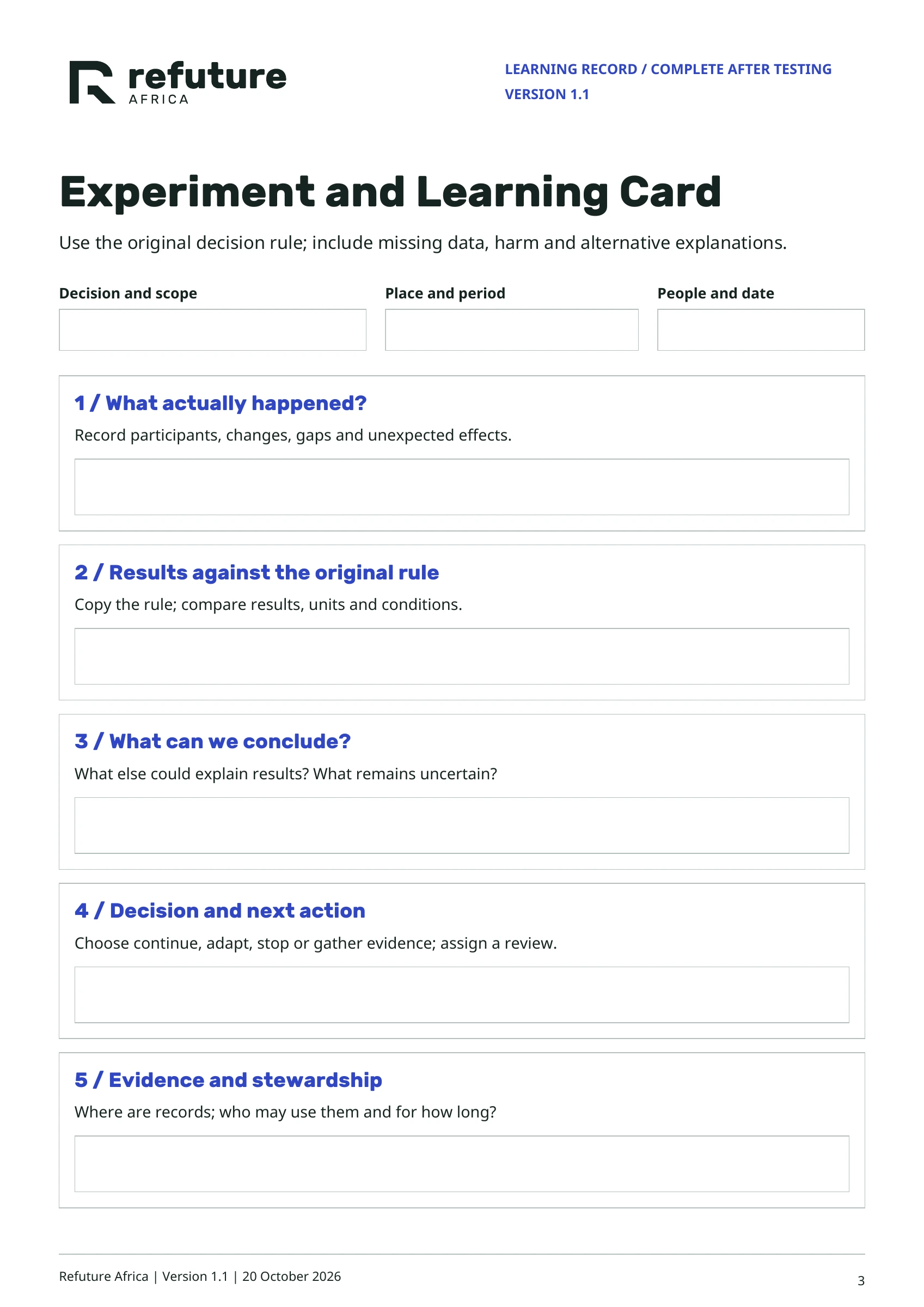
Experiment and Learning Card — page 3: Learning record / complete after testing
Read page 3 as text

Text follows the PDF’s reading order; use the page image to see relationships and table columns.

Worksheet entry labels

These labels identify the blank fields in this worksheet. Repeated row labels belong to separate entries.

  1. Decision and scope
  2. Place and period
  3. People and date
  4. 1 / What actually happened?. Record participants, changes, gaps and unexpected effects.
  5. 2 / Results against the original rule. Copy the rule; compare results, units and conditions.
  6. 3 / What can we conclude?. What else could explain results? What remains uncertain?
  7. 4 / Decision and next action. Choose continue, adapt, stop or gather evidence; assign a review.
  8. 5 / Evidence and stewardship. Where are records; who may use them and for how long?
LEARNING RECORD / COMPLETE AFTER TESTING VERSION 1.1 Experiment and Learning Card Use the original decision rule; include missing data, harm and alternative explanations. Decision and scope Place and period People and date 1 / What actually happened? Record participants, changes, gaps and unexpected effects. 2 / Results against the original rule Copy the rule; compare results, units and conditions. 3 / What can we conclude? What else could explain results? What remains uncertain? 4 / Decision and next action Choose continue, adapt, stop or gather evidence; assign a review. 5 / Evidence and stewardship Where are records; who may use them and for how long? Refuture Africa | Version 1.1 | 20 October 2026 3

4 / Shared fictional teaching case

Open full-size page 4 in a new tab ↗
Experiment and Learning Card — page 4: Shared fictional teaching case
Read page 4 as text

Text follows the PDF’s reading order; use the page image to see relationships and table columns.

SHARED FICTIONAL TEACHING CASE VERSION 1.1 Solar irrigation as a service Will growers receive enough value after all costs and fees to choose the service again? A design exercise, not a reported project. A fictional teaching venture. All participants, prices, volumes, costs and test thresholds are invented. No field results or Refuture project are represented. The proposed venture Twenty neighbouring growers each cultivate a quarter-acre vegetable plot: five acres in total. The proposed service uses an existing shared water source in an unnamed Kenyan farming area. Access rights, available water and system capacity still need checking. Growers pay for metered supplementary irrigation delivered to their plots, rather than buying a pump. The proposed operator supplies the equipment, scheduling, operation and maintenance. Growers continue to choose and manage their crops, with agreed crop-water advice. The value and the design tension The commercial proposition is better crop quality, more reliable production and improved crop margins after fees. Stronger soil health and local capability are longer-term intentions that require deliberate practice and separate evidence. A fee for each cubic metre makes the service simple to explain, but can reward selling more water. A viable enterprise must work inside an agreed water budget. If the price or funding model requires over-pumping, redesign the model. Use this tool at this stage The proposed test covers one complete crop cycle and a next-cycle payment decision, not four weeks by default. Pages 5-6 are a teaching sequence: a proposed plan, then invented results showing how to apply the rule. The result is deliberately mixed: 6.7% median gain and 8/10 paying again. No permission, participant, measurement or payment is real. Water rights, source capacity, operating conditions, participation and finance are unconfirmed. A committee cannot grant statutory rights or override other users. No paid trial should start before the relevant conditions and responsibilities are agreed. Refuture Africa | Version 1.1 | 20 October 2026 4

5 / Fictional plan / not an approved trial

Open full-size page 5 in a new tab ↗
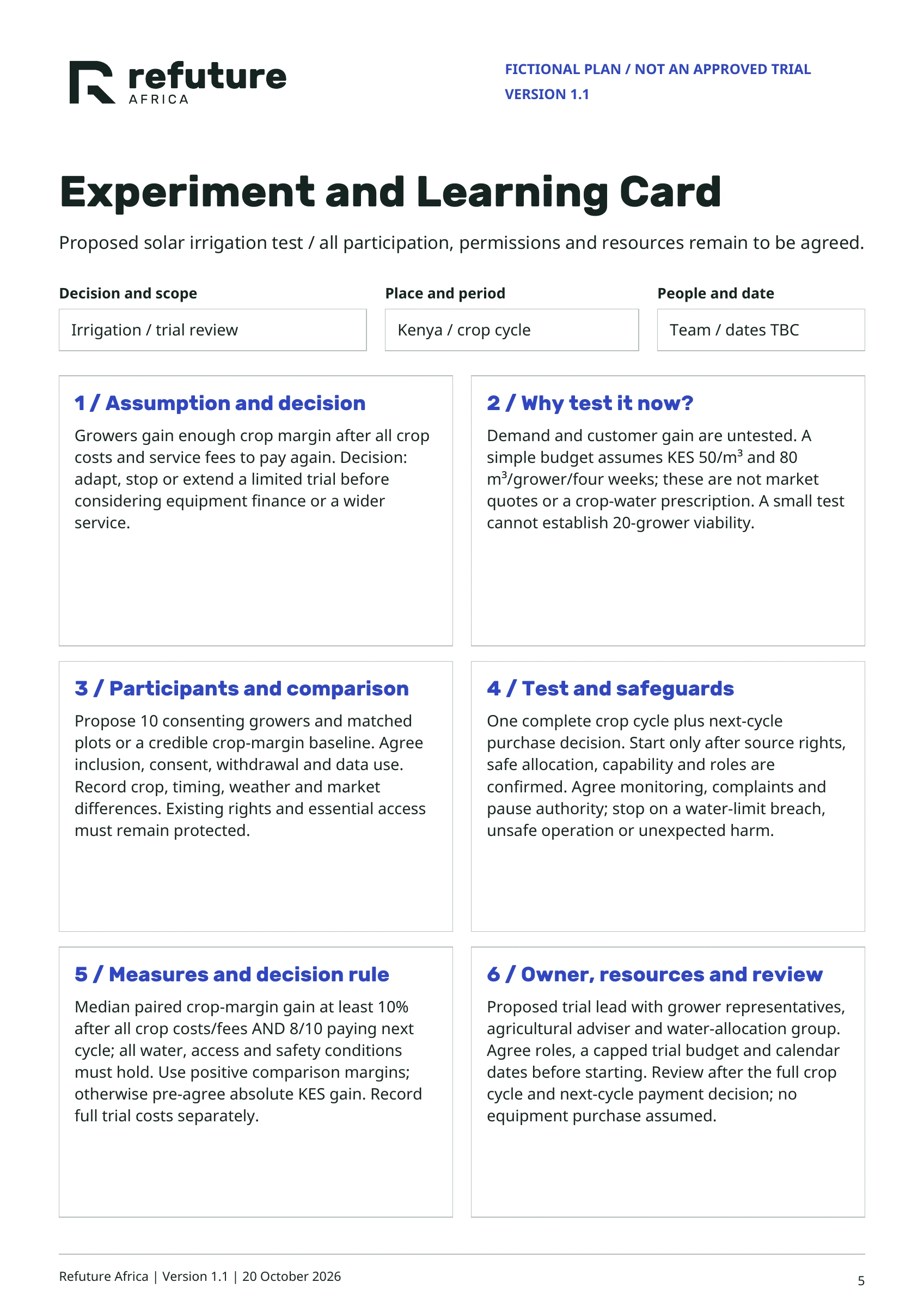
Experiment and Learning Card — page 5: Fictional plan / not an approved trial
Read page 5 as text

Text follows the PDF’s reading order; use the page image to see relationships and table columns.

FICTIONAL PLAN / NOT AN APPROVED TRIAL VERSION 1.1 Experiment and Learning Card Proposed solar irrigation test / all participation, permissions and resources remain to be agreed. Decision and scope Irrigation / trial review Place and period Kenya / crop cycle People and date Team / dates TBC 1 / Assumption and decision Growers gain enough crop margin after all crop costs and service fees to pay again. Decision: adapt, stop or extend a limited trial before considering equipment finance or a wider service. 2 / Why test it now? Demand and customer gain are untested. A simple budget assumes KES 50/m³ and 80 m³/grower/four weeks; these are not market quotes or a crop-water prescription. A small test cannot establish 20-grower viability. 3 / Participants and comparison Propose 10 consenting growers and matched plots or a credible crop-margin baseline. Agree inclusion, consent, withdrawal and data use. Record crop, timing, weather and market differences. Existing rights and essential access must remain protected. 4 / Test and safeguards One complete crop cycle plus next-cycle purchase decision. Start only after source rights, safe allocation, capability and roles are confirmed. Agree monitoring, complaints and pause authority; stop on a water-limit breach, unsafe operation or unexpected harm. 5 / Measures and decision rule Median paired crop-margin gain at least 10% after all crop costs/fees AND 8/10 paying next cycle; all water, access and safety conditions must hold. Use positive comparison margins; otherwise pre-agree absolute KES gain. Record full trial costs separately. 6 / Owner, resources and review Proposed trial lead with grower representatives, agricultural adviser and water-allocation group. Agree roles, a capped trial budget and calendar dates before starting. Review after the full crop cycle and next-cycle payment decision; no equipment purchase assumed. Refuture Africa | Version 1.1 | 20 October 2026 5

6 / Simulated learning / no field results

Open full-size page 6 in a new tab ↗
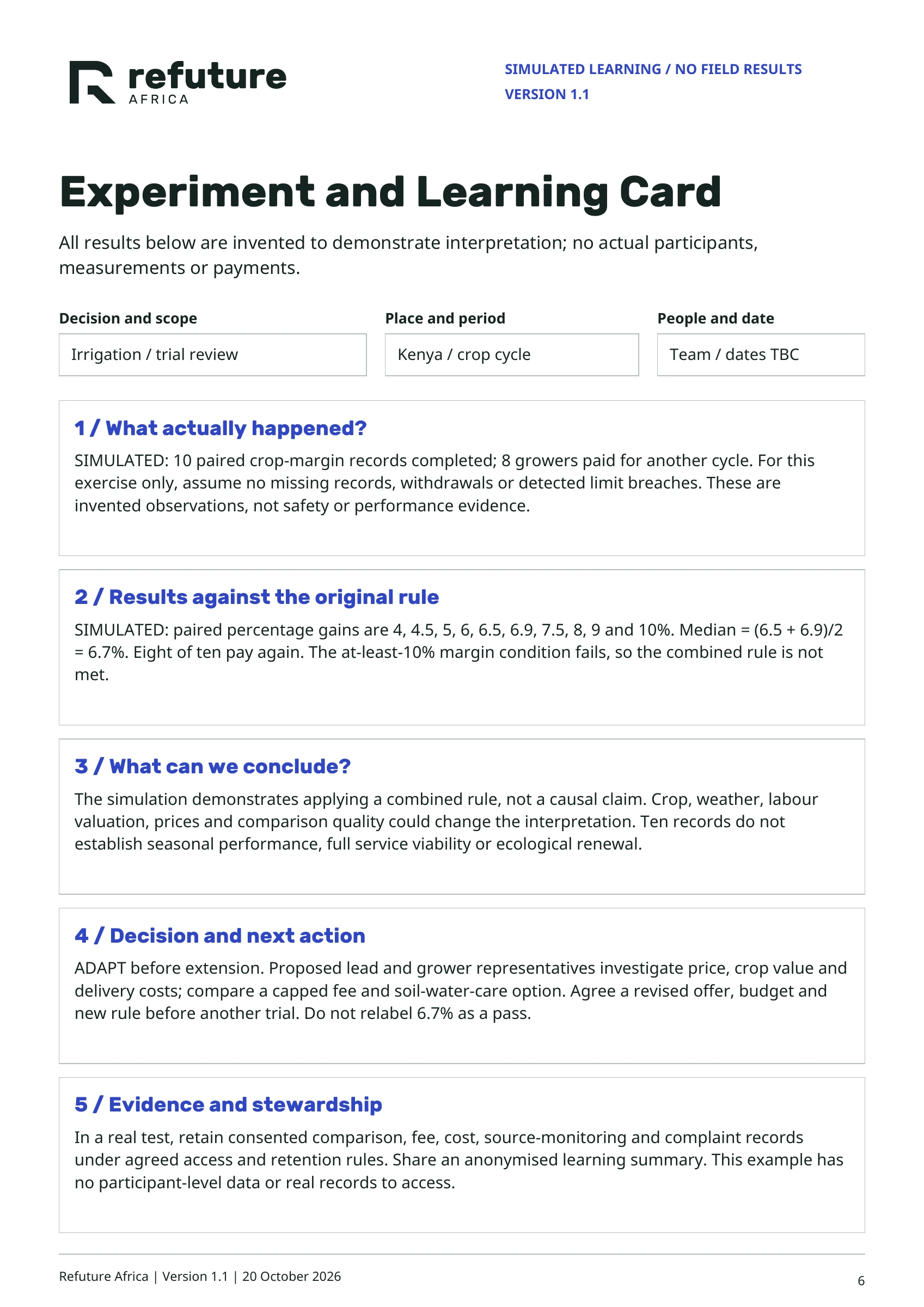
Experiment and Learning Card — page 6: Simulated learning / no field results
Read page 6 as text

Text follows the PDF’s reading order; use the page image to see relationships and table columns.

SIMULATED LEARNING / NO FIELD RESULTS VERSION 1.1 Experiment and Learning Card All results below are invented to demonstrate interpretation; no actual participants, measurements or payments. Decision and scope Irrigation / trial review Place and period Kenya / crop cycle People and date Team / dates TBC 1 / What actually happened? SIMULATED: 10 paired crop-margin records completed; 8 growers paid for another cycle. For this exercise only, assume no missing records, withdrawals or detected limit breaches. These are invented observations, not safety or performance evidence. 2 / Results against the original rule SIMULATED: paired percentage gains are 4, 4.5, 5, 6, 6.5, 6.9, 7.5, 8, 9 and 10%. Median = (6.5 + 6.9)/2 = 6.7%. Eight of ten pay again. The at-least-10% margin condition fails, so the combined rule is not met. 3 / What can we conclude? The simulation demonstrates applying a combined rule, not a causal claim. Crop, weather, labour valuation, prices and comparison quality could change the interpretation. Ten records do not establish seasonal performance, full service viability or ecological renewal. 4 / Decision and next action ADAPT before extension. Proposed lead and grower representatives investigate price, crop value and delivery costs; compare a capped fee and soil-water-care option. Agree a revised offer, budget and new rule before another trial. Do not relabel 6.7% as a pass. 5 / Evidence and stewardship In a real test, retain consented comparison, fee, cost, source-monitoring and complaint records under agreed access and retention rules. Share an anonymised learning summary. This example has no participant-level data or real records to access. Refuture Africa | Version 1.1 | 20 October 2026 6

7 / Review, evidence and use

Open full-size page 7 in a new tab ↗
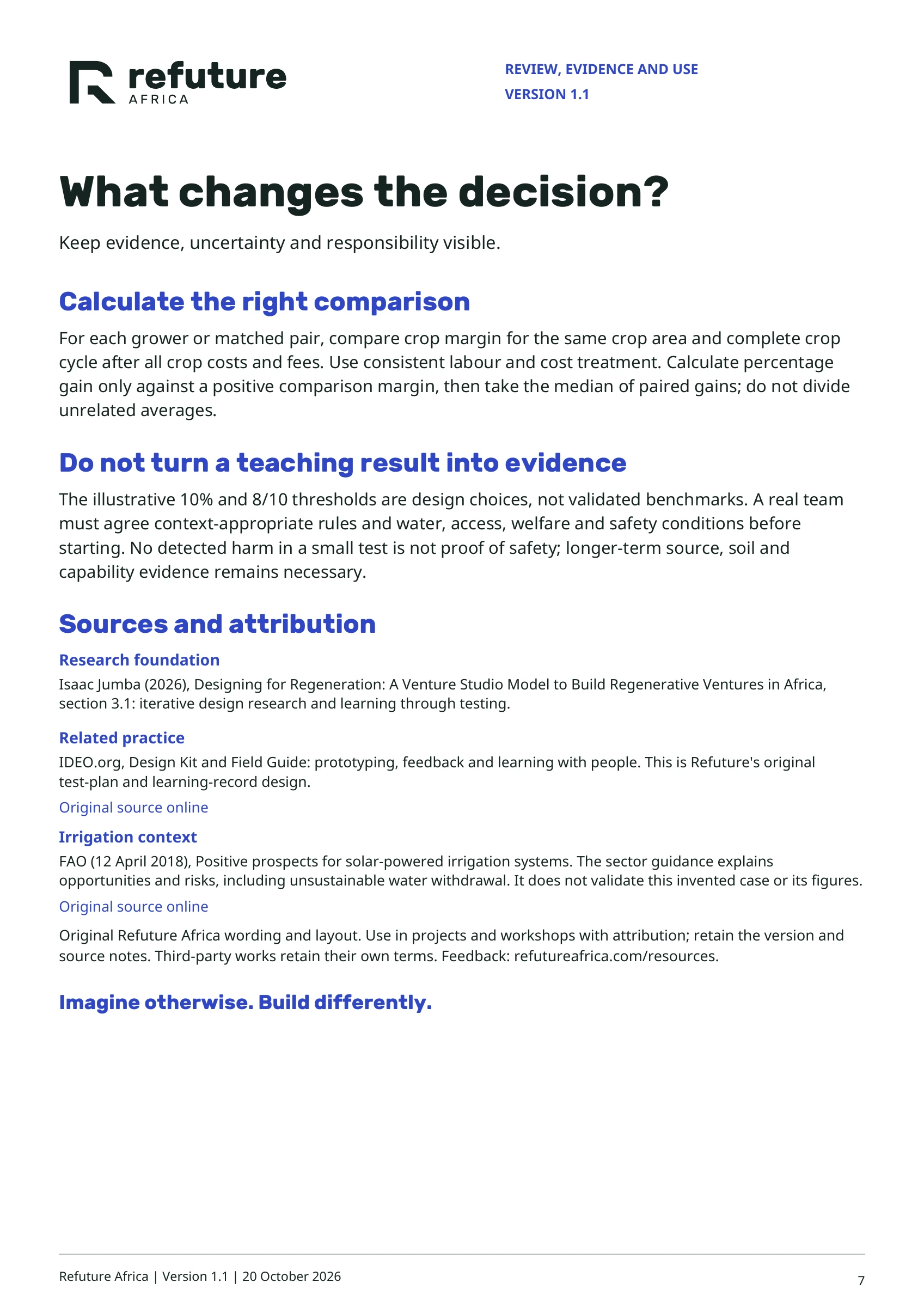
Experiment and Learning Card — page 7: Review, evidence and use
Read page 7 as text

Text follows the PDF’s reading order; use the page image to see relationships and table columns.

REVIEW, EVIDENCE AND USE VERSION 1.1 What changes the decision? Keep evidence, uncertainty and responsibility visible. Calculate the right comparison For each grower or matched pair, compare crop margin for the same crop area and complete crop cycle after all crop costs and fees. Use consistent labour and cost treatment. Calculate percentage gain only against a positive comparison margin, then take the median of paired gains; do not divide unrelated averages. Do not turn a teaching result into evidence The illustrative 10% and 8/10 thresholds are design choices, not validated benchmarks. A real team must agree context-appropriate rules and water, access, welfare and safety conditions before starting. No detected harm in a small test is not proof of safety; longer-term source, soil and capability evidence remains necessary. Sources and attribution Research foundation Isaac Jumba (2026), Designing for Regeneration: A Venture Studio Model to Build Regenerative Ventures in Africa, section 3.1: iterative design research and learning through testing. Related practice IDEO.org, Design Kit and Field Guide: prototyping, feedback and learning with people. This is Refuture's original test-plan and learning-record design. Original source online Irrigation context FAO (12 April 2018), Positive prospects for solar-powered irrigation systems. The sector guidance explains opportunities and risks, including unsustainable water withdrawal. It does not validate this invented case or its figures. Original source online Original Refuture Africa wording and layout. Use in projects and workshops with attribution; retain the version and source notes. Third-party works retain their own terms. Feedback: refutureafrica.com/resources. Imagine otherwise. Build differently. Refuture Africa | Version 1.1 | 20 October 2026 7

Ready to use it?

Download the fillable PDF to type into the worksheets or print them at the sizes shown in the guide.

Get the fillable PDF

Tell us what helped or was unclear →

Explore all eight tools →