Read page 1 as text
Text follows the PDF’s reading order; use the page image to see relationships and table columns.
TOOL GUIDE
VERSION 1.1
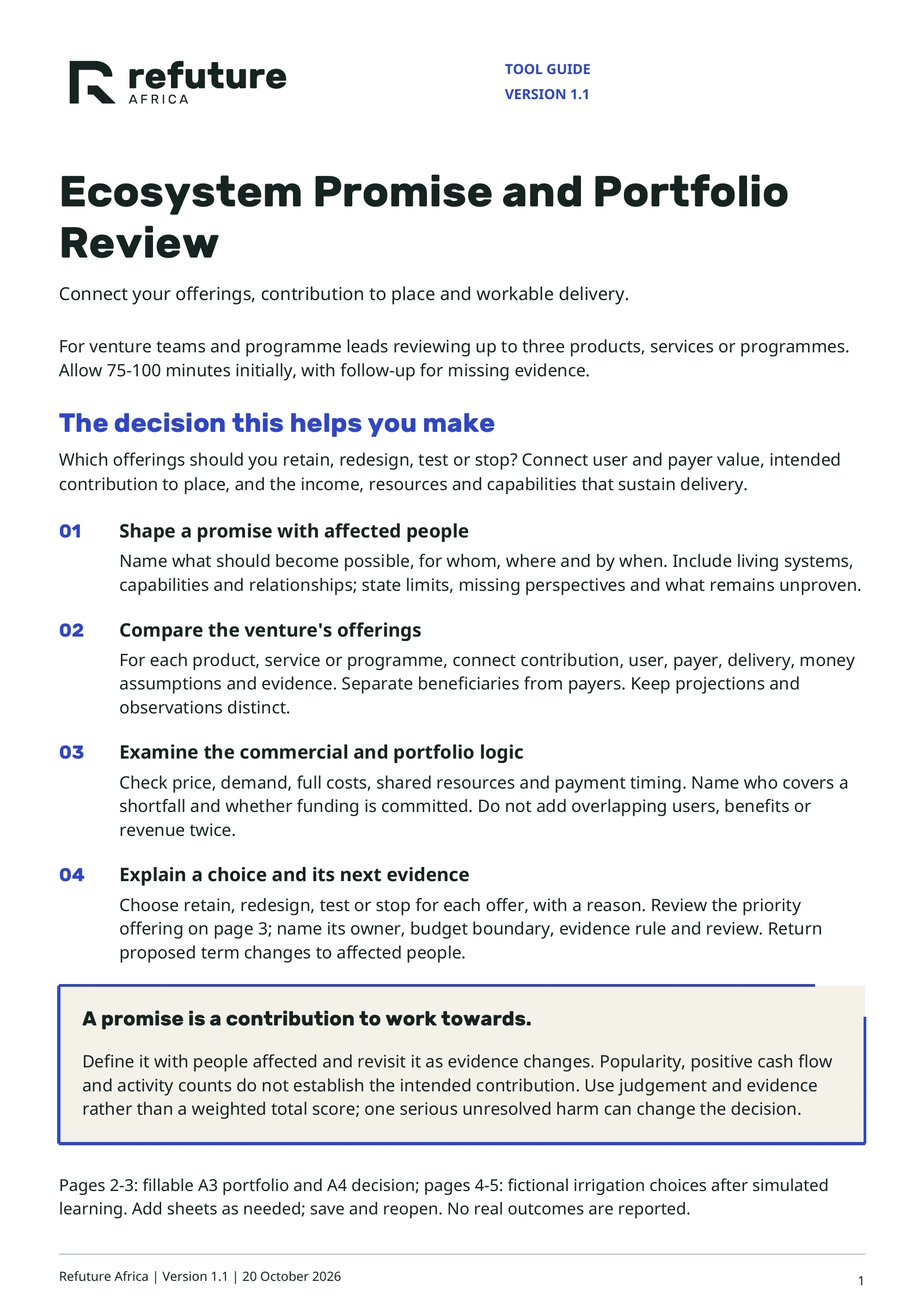
Ecosystem Promise and Portfolio
Review
Connect your offerings, contribution to place and workable delivery.
For venture teams and programme leads reviewing up to three products, services or programmes.
Allow 75-100 minutes initially, with follow-up for missing evidence.
The decision this helps you make
Which offerings should you retain, redesign, test or stop? Connect user and payer value, intended
contribution to place, and the income, resources and capabilities that sustain delivery.
01
Shape a promise with affected people
Name what should become possible, for whom, where and by when. Include living systems,
capabilities and relationships; state limits, missing perspectives and what remains unproven.
02
Compare the venture's offerings
For each product, service or programme, connect contribution, user, payer, delivery, money
assumptions and evidence. Separate beneficiaries from payers. Keep projections and
observations distinct.
03
Examine the commercial and portfolio logic
Check price, demand, full costs, shared resources and payment timing. Name who covers a
shortfall and whether funding is committed. Do not add overlapping users, benefits or
revenue twice.
04
Explain a choice and its next evidence
Choose retain, redesign, test or stop for each offer, with a reason. Review the priority
offering on page 3; name its owner, budget boundary, evidence rule and review. Return
proposed term changes to affected people.
A promise is a contribution to work towards.
Define it with people affected and revisit it as evidence changes. Popularity, positive cash flow
and activity counts do not establish the intended contribution. Use judgement and evidence
rather than a weighted total score; one serious unresolved harm can change the decision.
Pages 2-3: fillable A3 portfolio and A4 decision; pages 4-5: fictional irrigation choices after simulated
learning. Add sheets as needed; save and reopen. No real outcomes are reported.
Refuture Africa | Version 1.1 | 20 October 2026
1
Read page 2 as text
Text follows the PDF’s reading order; use the page image to see relationships and table columns.
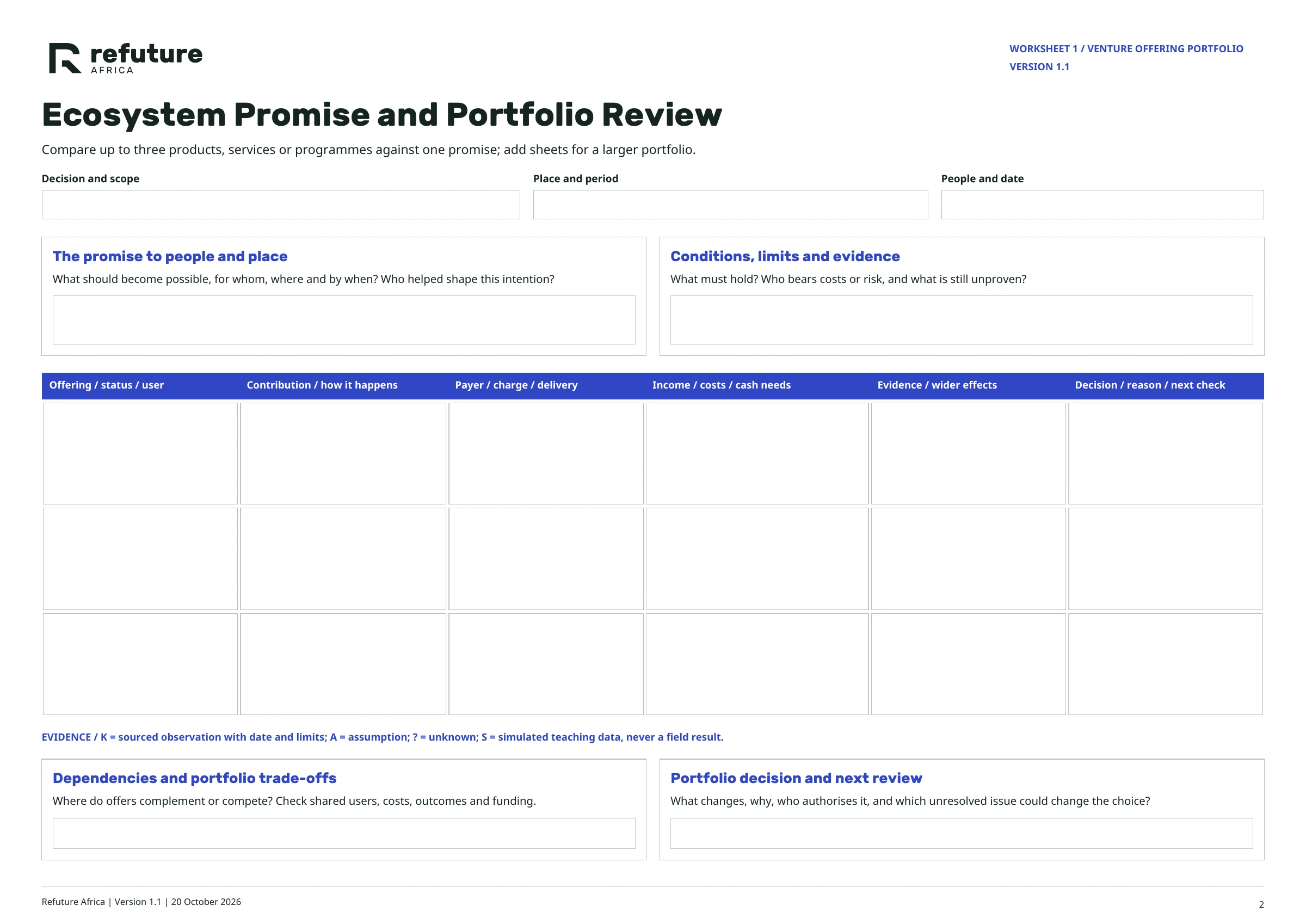
WORKSHEET 1 / VENTURE OFFERING PORTFOLIO
VERSION 1.1
Ecosystem Promise and Portfolio Review
Compare up to three products, services or programmes against one promise; add sheets for a larger portfolio.
Decision and scope
Place and period
People and date
The promise to people and place
What should become possible, for whom, where and by when? Who helped shape this intention?
Conditions, limits and evidence
What must hold? Who bears costs or risk, and what is still unproven?
Offering / status / user
Contribution / how it happens
Payer / charge / delivery
Income / costs / cash needs
Evidence / wider effects
Decision / reason / next check
EVIDENCE / K = sourced observation with date and limits; A = assumption; ? = unknown; S = simulated teaching data, never a field result.
Dependencies and portfolio trade-offs
Where do offers complement or compete? Check shared users, costs, outcomes and funding.
Portfolio decision and next review
What changes, why, who authorises it, and which unresolved issue could change the choice?
Refuture Africa | Version 1.1 | 20 October 2026
2
Read page 3 as text
Text follows the PDF’s reading order; use the page image to see relationships and table columns.
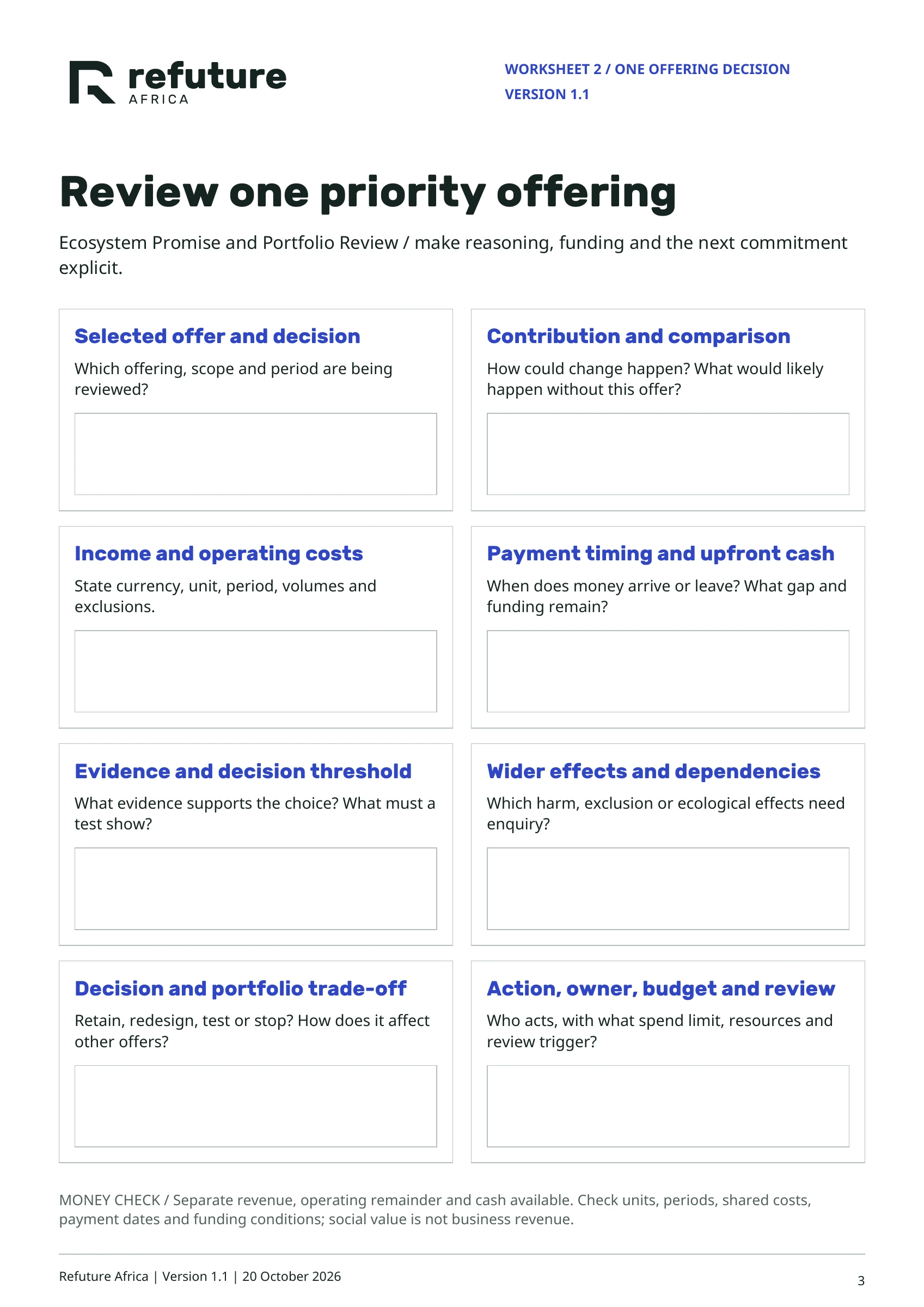
WORKSHEET 2 / ONE OFFERING DECISION
VERSION 1.1
Review one priority offering
Ecosystem Promise and Portfolio Review / make reasoning, funding and the next commitment
explicit.
Selected offer and decision
Which offering, scope and period are being
reviewed?
Contribution and comparison
How could change happen? What would likely
happen without this offer?
Income and operating costs
State currency, unit, period, volumes and
exclusions.
Payment timing and upfront cash
When does money arrive or leave? What gap and
funding remain?
Evidence and decision threshold
What evidence supports the choice? What must a
test show?
Wider effects and dependencies
Which harm, exclusion or ecological effects need
enquiry?
Decision and portfolio trade-off
Retain, redesign, test or stop? How does it affect
other offers?
Action, owner, budget and review
Who acts, with what spend limit, resources and
review trigger?
MONEY CHECK / Separate revenue, operating remainder and cash available. Check units, periods, shared costs,
payment dates and funding conditions; social value is not business revenue.
Refuture Africa | Version 1.1 | 20 October 2026
3
Read page 4 as text
Text follows the PDF’s reading order; use the page image to see relationships and table columns.
WORKED PORTFOLIO / SIMULATED
VERSION 1.1
Ecosystem Promise and Portfolio Review
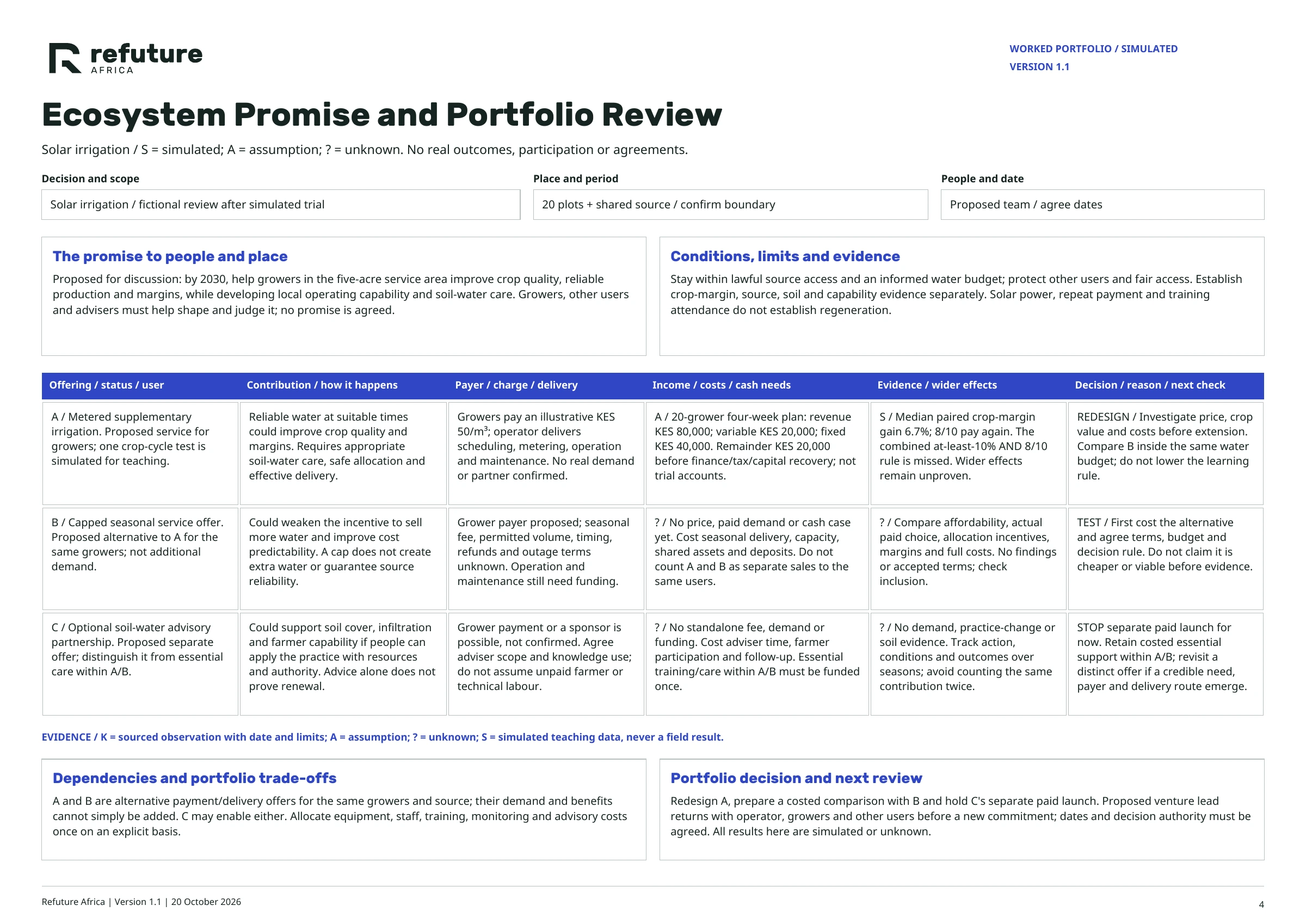
Solar irrigation / S = simulated; A = assumption; ? = unknown. No real outcomes, participation or agreements.
Decision and scope
Solar irrigation / fictional review after simulated trial
Place and period
20 plots + shared source / confirm boundary
People and date
Proposed team / agree dates
The promise to people and place
Proposed for discussion: by 2030, help growers in the five-acre service area improve crop quality, reliable
production and margins, while developing local operating capability and soil-water care. Growers, other users
and advisers must help shape and judge it; no promise is agreed.
Conditions, limits and evidence
Stay within lawful source access and an informed water budget; protect other users and fair access. Establish
crop-margin, source, soil and capability evidence separately. Solar power, repeat payment and training
attendance do not establish regeneration.
Offering / status / user
Contribution / how it happens
Payer / charge / delivery
Income / costs / cash needs
Evidence / wider effects
Decision / reason / next check
A / Metered supplementary
irrigation. Proposed service for
growers; one crop-cycle test is
simulated for teaching.
Reliable water at suitable times
could improve crop quality and
margins. Requires appropriate
soil-water care, safe allocation and
effective delivery.
Growers pay an illustrative KES
50/m³; operator delivers
scheduling, metering, operation
and maintenance. No real demand
or partner confirmed.
A / 20-grower four-week plan: revenue
KES 80,000; variable KES 20,000; fixed
KES 40,000. Remainder KES 20,000
before finance/tax/capital recovery; not
trial accounts.
S / Median paired crop-margin
gain 6.7%; 8/10 pay again. The
combined at-least-10% AND 8/10
rule is missed. Wider effects
remain unproven.
REDESIGN / Investigate price, crop
value and costs before extension.
Compare B inside the same water
budget; do not lower the learning
rule.
B / Capped seasonal service offer.
Proposed alternative to A for the
same growers; not additional
demand.
Could weaken the incentive to sell
more water and improve cost
predictability. A cap does not create
extra water or guarantee source
reliability.
Grower payer proposed; seasonal
fee, permitted volume, timing,
refunds and outage terms
unknown. Operation and
maintenance still need funding.
? / No price, paid demand or cash case
yet. Cost seasonal delivery, capacity,
shared assets and deposits. Do not
count A and B as separate sales to the
same users.
? / Compare affordability, actual
paid choice, allocation incentives,
margins and full costs. No findings
or accepted terms; check
inclusion.
TEST / First cost the alternative
and agree terms, budget and
decision rule. Do not claim it is
cheaper or viable before evidence.
C / Optional soil-water advisory
partnership. Proposed separate
offer; distinguish it from essential
care within A/B.
Could support soil cover, infiltration
and farmer capability if people can
apply the practice with resources
and authority. Advice alone does not
prove renewal.
Grower payment or a sponsor is
possible, not confirmed. Agree
adviser scope and knowledge use;
do not assume unpaid farmer or
technical labour.
? / No standalone fee, demand or
funding. Cost adviser time, farmer
participation and follow-up. Essential
training/care within A/B must be funded
once.
? / No demand, practice-change or
soil evidence. Track action,
conditions and outcomes over
seasons; avoid counting the same
contribution twice.
STOP separate paid launch for
now. Retain costed essential
support within A/B; revisit a
distinct offer if a credible need,
payer and delivery route emerge.
EVIDENCE / K = sourced observation with date and limits; A = assumption; ? = unknown; S = simulated teaching data, never a field result.
Dependencies and portfolio trade-offs
A and B are alternative payment/delivery offers for the same growers and source; their demand and benefits
cannot simply be added. C may enable either. Allocate equipment, staff, training, monitoring and advisory costs
once on an explicit basis.
Portfolio decision and next review
Redesign A, prepare a costed comparison with B and hold C's separate paid launch. Proposed venture lead
returns with operator, growers and other users before a new commitment; dates and decision authority must be
agreed. All results here are simulated or unknown.
Refuture Africa | Version 1.1 | 20 October 2026
4
Read page 5 as text
Text follows the PDF’s reading order; use the page image to see relationships and table columns.
WORKED OFFERING DECISION / FICTIONAL
VERSION 1.1
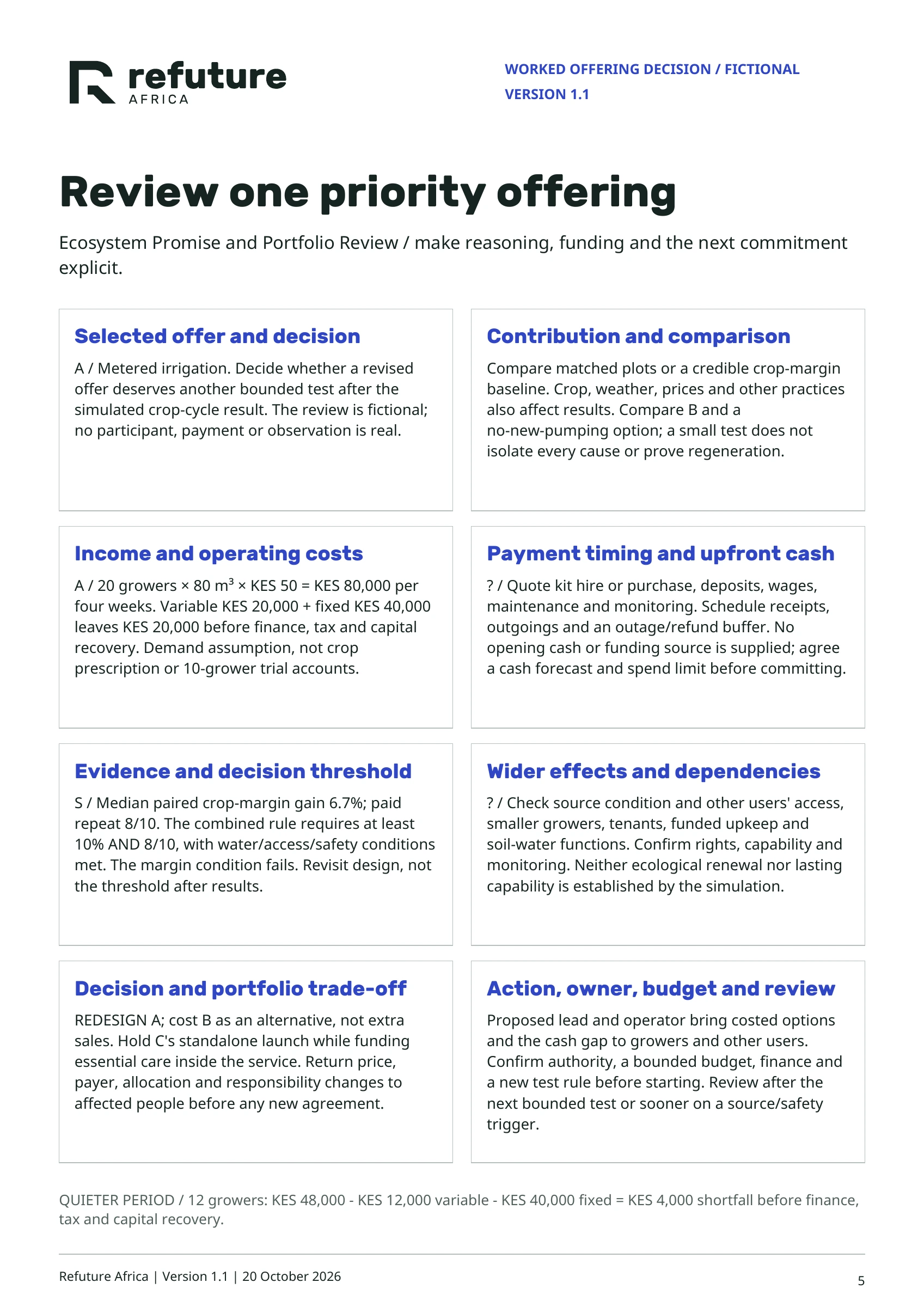
Review one priority offering
Ecosystem Promise and Portfolio Review / make reasoning, funding and the next commitment
explicit.
Selected offer and decision
A / Metered irrigation. Decide whether a revised
offer deserves another bounded test after the
simulated crop-cycle result. The review is fictional;
no participant, payment or observation is real.
Contribution and comparison
Compare matched plots or a credible crop-margin
baseline. Crop, weather, prices and other practices
also affect results. Compare B and a
no-new-pumping option; a small test does not
isolate every cause or prove regeneration.
Income and operating costs
A / 20 growers × 80 m³ × KES 50 = KES 80,000 per
four weeks. Variable KES 20,000 + fixed KES 40,000
leaves KES 20,000 before finance, tax and capital
recovery. Demand assumption, not crop
prescription or 10-grower trial accounts.
Payment timing and upfront cash
? / Quote kit hire or purchase, deposits, wages,
maintenance and monitoring. Schedule receipts,
outgoings and an outage/refund buffer. No
opening cash or funding source is supplied; agree
a cash forecast and spend limit before committing.
Evidence and decision threshold
S / Median paired crop-margin gain 6.7%; paid
repeat 8/10. The combined rule requires at least
10% AND 8/10, with water/access/safety conditions
met. The margin condition fails. Revisit design, not
the threshold after results.
Wider effects and dependencies
? / Check source condition and other users' access,
smaller growers, tenants, funded upkeep and
soil-water functions. Confirm rights, capability and
monitoring. Neither ecological renewal nor lasting
capability is established by the simulation.
Decision and portfolio trade-off
REDESIGN A; cost B as an alternative, not extra
sales. Hold C's standalone launch while funding
essential care inside the service. Return price,
payer, allocation and responsibility changes to
affected people before any new agreement.
Action, owner, budget and review
Proposed lead and operator bring costed options
and the cash gap to growers and other users.
Confirm authority, a bounded budget, finance and
a new test rule before starting. Review after the
next bounded test or sooner on a source/safety
trigger.
QUIETER PERIOD / 12 growers: KES 48,000 - KES 12,000 variable - KES 40,000 fixed = KES 4,000 shortfall before finance,
tax and capital recovery.
Refuture Africa | Version 1.1 | 20 October 2026
5
Read page 6 as text
Text follows the PDF’s reading order; use the page image to see relationships and table columns.
REVIEW, EVIDENCE AND USE
VERSION 1.1
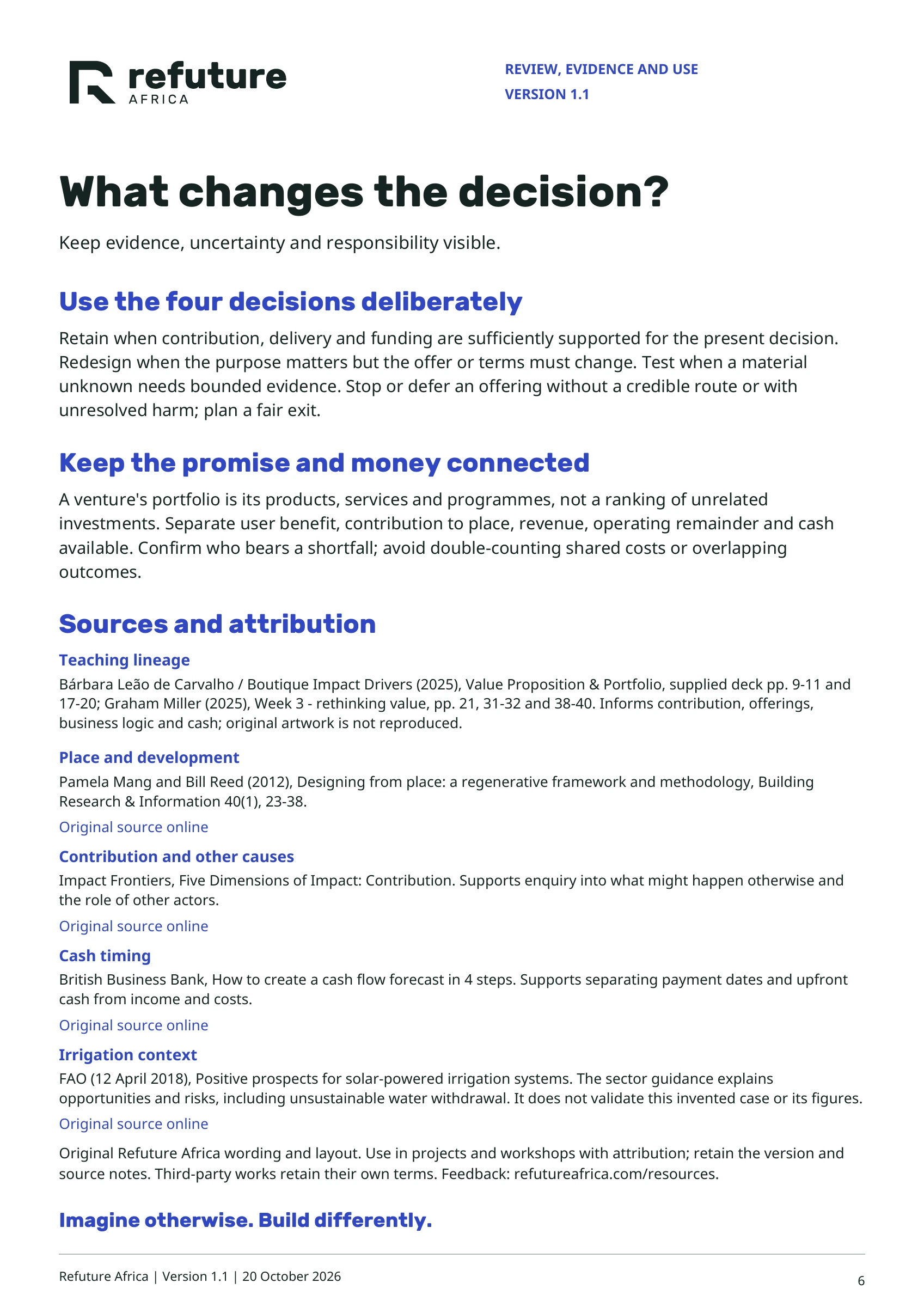
What changes the decision?
Keep evidence, uncertainty and responsibility visible.
Use the four decisions deliberately
Retain when contribution, delivery and funding are sufficiently supported for the present decision.
Redesign when the purpose matters but the offer or terms must change. Test when a material
unknown needs bounded evidence. Stop or defer an offering without a credible route or with
unresolved harm; plan a fair exit.
Keep the promise and money connected
A venture's portfolio is its products, services and programmes, not a ranking of unrelated
investments. Separate user benefit, contribution to place, revenue, operating remainder and cash
available. Confirm who bears a shortfall; avoid double-counting shared costs or overlapping
outcomes.
Sources and attribution
Teaching lineage
Bárbara Leão de Carvalho / Boutique Impact Drivers (2025), Value Proposition & Portfolio, supplied deck pp. 9-11 and
17-20; Graham Miller (2025), Week 3 - rethinking value, pp. 21, 31-32 and 38-40. Informs contribution, offerings,
business logic and cash; original artwork is not reproduced.
Place and development
Pamela Mang and Bill Reed (2012), Designing from place: a regenerative framework and methodology, Building
Research & Information 40(1), 23-38.
Original source online
Contribution and other causes
Impact Frontiers, Five Dimensions of Impact: Contribution. Supports enquiry into what might happen otherwise and
the role of other actors.
Original source online
Cash timing
British Business Bank, How to create a cash flow forecast in 4 steps. Supports separating payment dates and upfront
cash from income and costs.
Original source online
Irrigation context
FAO (12 April 2018), Positive prospects for solar-powered irrigation systems. The sector guidance explains
opportunities and risks, including unsustainable water withdrawal. It does not validate this invented case or its figures.
Original source online
Original Refuture Africa wording and layout. Use in projects and workshops with attribution; retain the version and
source notes. Third-party works retain their own terms. Feedback: refutureafrica.com/resources.
Imagine otherwise. Build differently.
Refuture Africa | Version 1.1 | 20 October 2026
6