
← All tools

Refuture Africa / Online preview / Version 1.1

Capability & Stewardship Review

Choose capabilities to develop through real work and identify the time, authority and resources they need. Agree responsibility for upkeep, knowledge, handover and change.

Read all 6 pages below, including the guide, worksheets and examples. This preview is read-only. To complete the worksheets, download the fillable PDF with your name and email.

On a small screen, open a full-size page to zoom, or expand its text view. The PDFs are not fully tagged for screen readers. Use the online text view if it works better with your assistive technology.

Worked examples use a fictional solar irrigation service. Assumptions, proposals and simulated results are labelled in the tools.

Facilitator guide: prepare and run a session

Prepare

For venture teams, institutions and local partners preparing, reviewing or handing over work. Allow 75-100 min + practice review. Invite people affected by the decision and people who can explain how delivery, money and decision rights work. Agree consent, attribution and how disagreements will be recorded.

Bring relevant evidence with sources and dates, a printed worksheet or a PDF editor, and a way to record unresolved questions. Read the teaching example beforehand; its invented figures are not benchmarks.

Run the session

  1. Begin with purpose and existing strengths

    Agree the place and next decision with people affected. Ask what they know, what already works and what they want to become able to do.

  2. Examine practice at three levels

    Consider individual judgement, team working and wider partnerships or place. Record observations, assumptions and unknowns; do not infer a skill deficit from a disappointing result alone.

  3. Develop through real work and support

    Choose a useful task or judgement, a supported chance to practise and evidence of progress. Check time, money, information, authority and relationships before prescribing training.

  4. Plan care and review the next commitment

    Agree accepted roles, funding, records, upkeep, backup and exit. Prioritise one or two commitments; confirm resources and a review before deciding to continue, adapt, pause or hand over.

Check the quality

Look for applied judgement and adaptation in real work, with appropriate support. Stewardship means accepted responsibility and practical means for continuing care. Knowing what to do is insufficient without time, resources, information or authority. Do not rate personalities or transfer open-ended business risks to volunteers.

Separate what is known, assumed and still to explore. Invite a different view before agreeing the next action. A proposed commitment stays a proposal until the responsible people confirm it.

Close and follow through

Read back the decision, evidence gaps, owner, resources and review date. Record what would make the team pause or change course. Share the record with participants and confirm corrections.

Use the worksheet

Pages 2-3: fillable A3 capability and A4 stewardship; pages 4-5: fictional review with simulated practice observations and proposed support. No real capability is assessed. Save and reopen; share only agreed, non-sensitive evidence.

Capability & Stewardship Review — page 1: Tool guide
Read page 1 as text

Text follows the PDF’s reading order; use the page image to see relationships and table columns.

TOOL GUIDE VERSION 1.1 Capability and Stewardship Review Develop the ability to act and adapt, with the means to sustain the work. For venture teams, institutions and local partners preparing, reviewing or handing over work. Allow 75-100 minutes initially, then review evidence through practice. The decision this helps you make Choose the capability to develop next, the conditions that enable it and who will care for the work over time. Leave with practice commitments, a stewardship plan and evidence for the next decision. 01 Begin with purpose and existing strengths Agree the place and next decision with people affected. Ask what they know, what already works and what they want to become able to do. 02 Examine practice at three levels Consider individual judgement, team working and wider partnerships or place. Record observations, assumptions and unknowns; do not infer a skill deficit from a disappointing result alone. 03 Develop through real work and support Choose a useful task or judgement, a supported chance to practise and evidence of progress. Check time, money, information, authority and relationships before prescribing training. 04 Plan care and review the next commitment Agree accepted roles, funding, records, upkeep, backup and exit. Prioritise one or two commitments; confirm resources and a review before deciding to continue, adapt, pause or hand over. Capability is more than confidence or attendance. Look for applied judgement and adaptation in real work, with appropriate support. Stewardship means accepted responsibility and practical means for continuing care. Knowing what to do is insufficient without time, resources, information or authority. Do not rate personalities or transfer open-ended business risks to volunteers. Pages 2-3: fillable A3 capability and A4 stewardship; pages 4-5: fictional review with simulated practice observations and proposed support. No real capability is assessed. Save and reopen; share only agreed, non-sensitive evidence. Refuture Africa | Version 1.1 | 20 October 2026 1

2 / Worksheet 1 / capability through practice

Open full-size page 2 in a new tab ↗
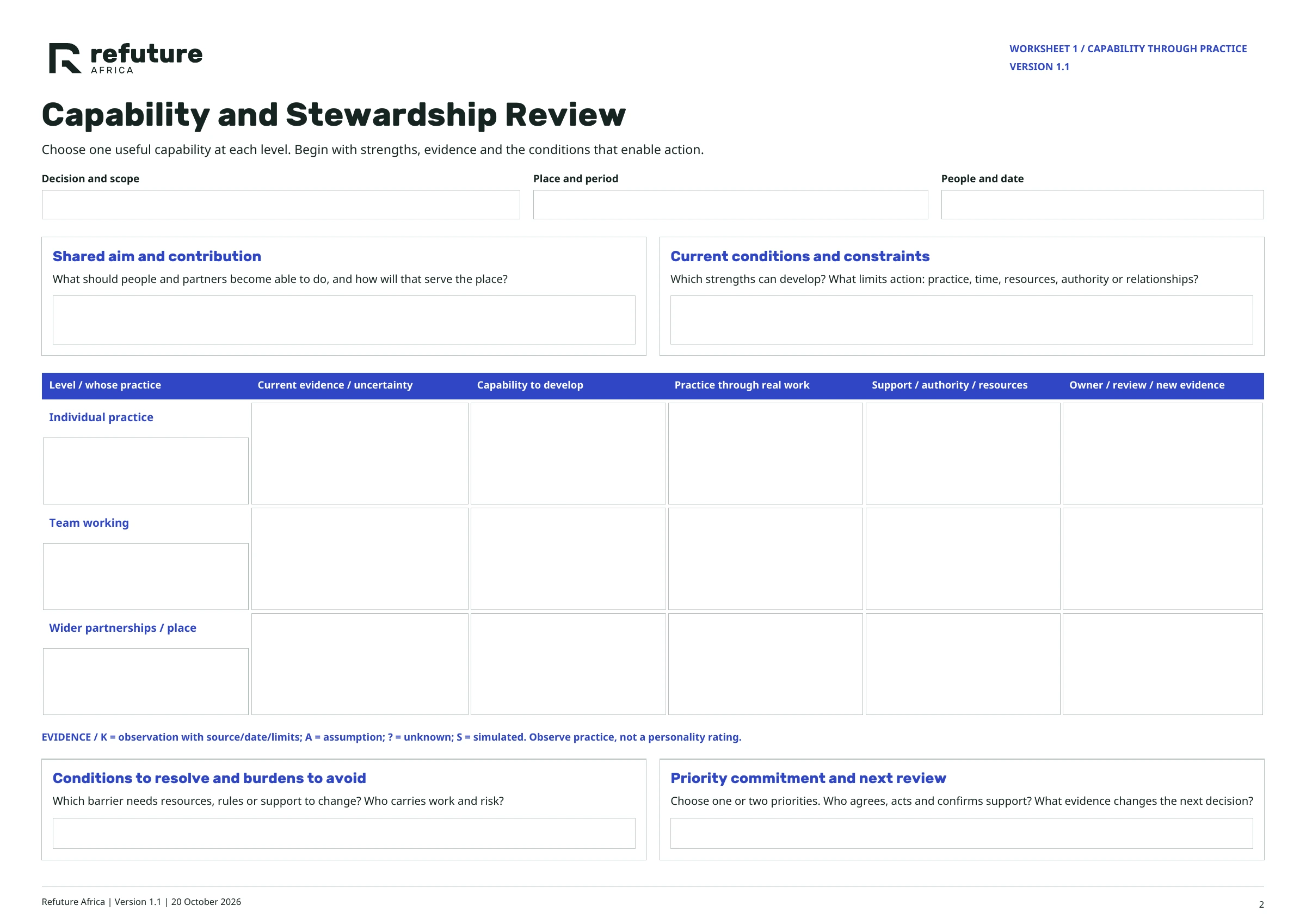
Capability & Stewardship Review — page 2: Worksheet 1 / capability through practice
Read page 2 as text

Text follows the PDF’s reading order; use the page image to see relationships and table columns.

Worksheet entry labels

These labels identify the blank fields in this worksheet. Repeated row labels belong to separate entries.

  1. Decision and scope
  2. Place and period
  3. People and date
  4. Shared aim and contribution. What should people and partners become able to do, and how will that serve the place?
  5. Current conditions and constraints. Which strengths can develop? What limits action: practice, time, resources, authority or relationships?
  6. Individual practice: whose practice and focus?
  7. Current evidence / uncertainty, Individual practice
  8. Capability to develop, Individual practice
  9. Practice through real work, Individual practice
  10. Support / authority / resources, Individual practice
  11. Owner / review / new evidence, Individual practice
  12. Team working: whose practice and focus?
  13. Current evidence / uncertainty, Team working
  14. Capability to develop, Team working
  15. Practice through real work, Team working
  16. Support / authority / resources, Team working
  17. Owner / review / new evidence, Team working
  18. Wider partnerships / place: whose practice and focus?
  19. Current evidence / uncertainty, Wider partnerships / place
  20. Capability to develop, Wider partnerships / place
  21. Practice through real work, Wider partnerships / place
  22. Support / authority / resources, Wider partnerships / place
  23. Owner / review / new evidence, Wider partnerships / place
  24. Conditions to resolve and burdens to avoid. Which barrier needs resources, rules or support to change? Who carries work and risk?
  25. Priority commitment and next review. Choose one or two priorities. Who agrees, acts and confirms support? What evidence changes the next decision?
WORKSHEET 1 / CAPABILITY THROUGH PRACTICE VERSION 1.1 Capability and Stewardship Review Choose one useful capability at each level. Begin with strengths, evidence and the conditions that enable action. Decision and scope Place and period People and date Shared aim and contribution What should people and partners become able to do, and how will that serve the place? Current conditions and constraints Which strengths can develop? What limits action: practice, time, resources, authority or relationships? Level / whose practice Current evidence / uncertainty Capability to develop Practice through real work Support / authority / resources Owner / review / new evidence Individual practice Team working Wider partnerships / place EVIDENCE / K = observation with source/date/limits; A = assumption; ? = unknown; S = simulated. Observe practice, not a personality rating. Conditions to resolve and burdens to avoid Which barrier needs resources, rules or support to change? Who carries work and risk? Priority commitment and next review Choose one or two priorities. Who agrees, acts and confirms support? What evidence changes the next decision? Refuture Africa | Version 1.1 | 20 October 2026 2

3 / Worksheet 2 / stewardship

Open full-size page 3 in a new tab ↗
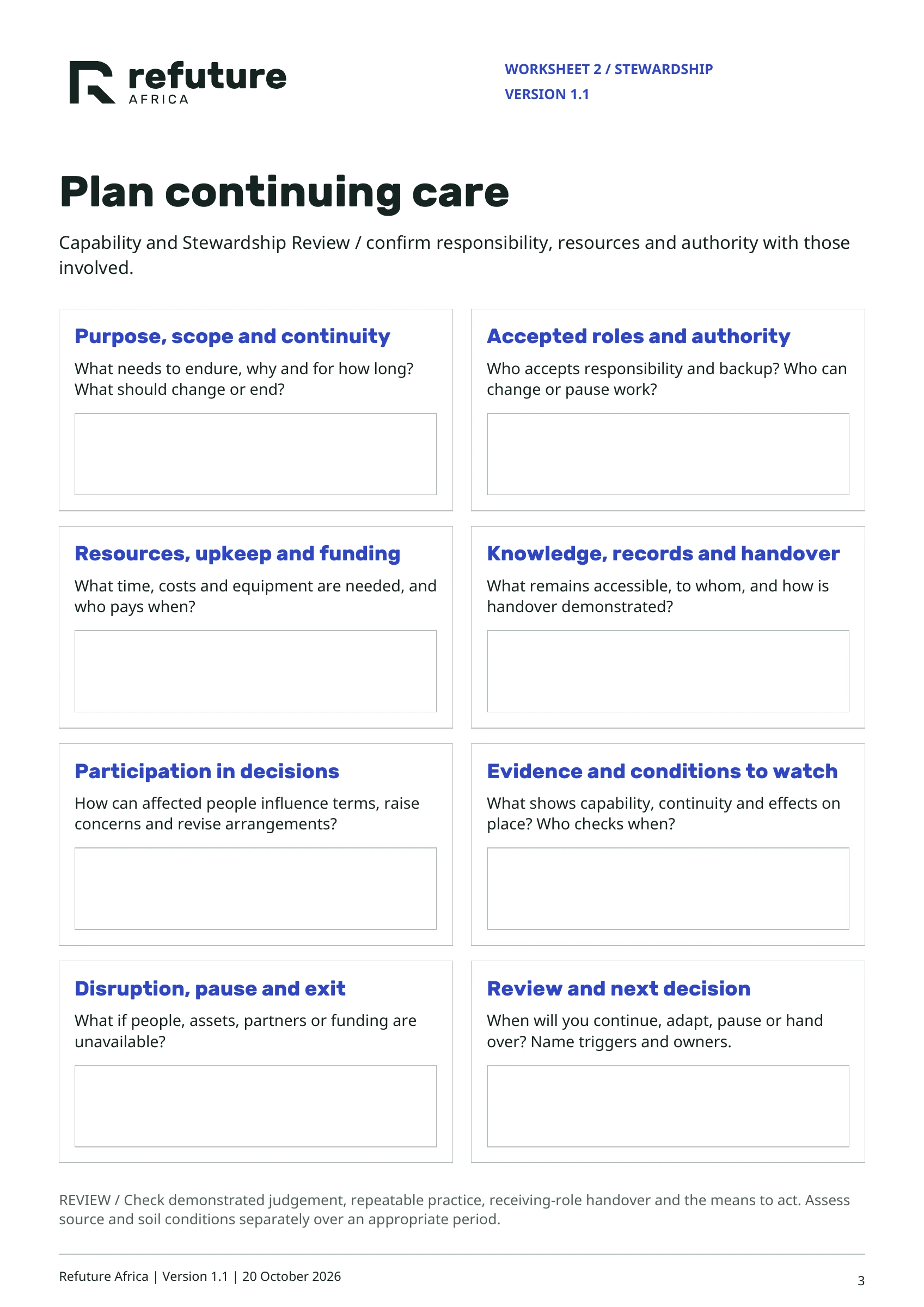
Capability & Stewardship Review — page 3: Worksheet 2 / stewardship
Read page 3 as text

Text follows the PDF’s reading order; use the page image to see relationships and table columns.

Worksheet entry labels

These labels identify the blank fields in this worksheet. Repeated row labels belong to separate entries.

  1. Purpose, scope and continuity. What needs to endure, why and for how long? What should change or end?
  2. Accepted roles and authority. Who accepts responsibility and backup? Who can change or pause work?
  3. Resources, upkeep and funding. What time, costs and equipment are needed, and who pays when?
  4. Knowledge, records and handover. What remains accessible, to whom, and how is handover demonstrated?
  5. Participation in decisions. How can affected people influence terms, raise concerns and revise arrangements?
  6. Evidence and conditions to watch. What shows capability, continuity and effects on place? Who checks when?
  7. Disruption, pause and exit. What if people, assets, partners or funding are unavailable?
  8. Review and next decision. When will you continue, adapt, pause or hand over? Name triggers and owners.
WORKSHEET 2 / STEWARDSHIP VERSION 1.1 Plan continuing care Capability and Stewardship Review / confirm responsibility, resources and authority with those involved. Purpose, scope and continuity What needs to endure, why and for how long? What should change or end? Accepted roles and authority Who accepts responsibility and backup? Who can change or pause work? Resources, upkeep and funding What time, costs and equipment are needed, and who pays when? Knowledge, records and handover What remains accessible, to whom, and how is handover demonstrated? Participation in decisions How can affected people influence terms, raise concerns and revise arrangements? Evidence and conditions to watch What shows capability, continuity and effects on place? Who checks when? Disruption, pause and exit What if people, assets, partners or funding are unavailable? Review and next decision When will you continue, adapt, pause or hand over? Name triggers and owners. REVIEW / Check demonstrated judgement, repeatable practice, receiving-role handover and the means to act. Assess source and soil conditions separately over an appropriate period. Refuture Africa | Version 1.1 | 20 October 2026 3

4 / Worked capability / simulated

Open full-size page 4 in a new tab ↗
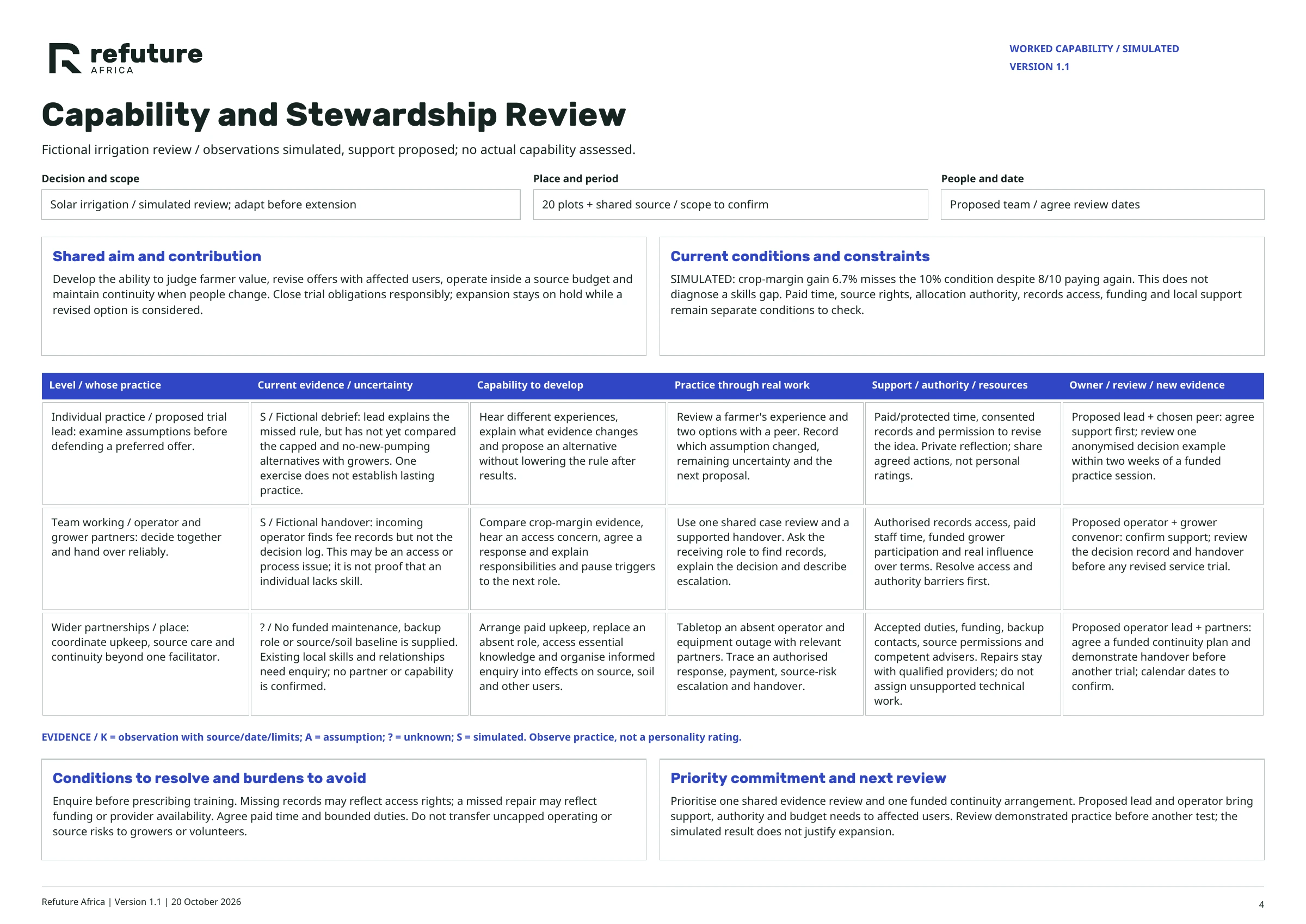
Capability & Stewardship Review — page 4: Worked capability / simulated
Read page 4 as text

Text follows the PDF’s reading order; use the page image to see relationships and table columns.

WORKED CAPABILITY / SIMULATED VERSION 1.1 Capability and Stewardship Review Fictional irrigation review / observations simulated, support proposed; no actual capability assessed. Decision and scope Solar irrigation / simulated review; adapt before extension Place and period 20 plots + shared source / scope to confirm People and date Proposed team / agree review dates Shared aim and contribution Develop the ability to judge farmer value, revise offers with affected users, operate inside a source budget and maintain continuity when people change. Close trial obligations responsibly; expansion stays on hold while a revised option is considered. Current conditions and constraints SIMULATED: crop-margin gain 6.7% misses the 10% condition despite 8/10 paying again. This does not diagnose a skills gap. Paid time, source rights, allocation authority, records access, funding and local support remain separate conditions to check. Level / whose practice Current evidence / uncertainty Capability to develop Practice through real work Support / authority / resources Owner / review / new evidence Individual practice / proposed trial lead: examine assumptions before defending a preferred offer. S / Fictional debrief: lead explains the missed rule, but has not yet compared the capped and no-new-pumping alternatives with growers. One exercise does not establish lasting practice. Hear different experiences, explain what evidence changes and propose an alternative without lowering the rule after results. Review a farmer's experience and two options with a peer. Record which assumption changed, remaining uncertainty and the next proposal. Paid/protected time, consented records and permission to revise the idea. Private reflection; share agreed actions, not personal ratings. Proposed lead + chosen peer: agree support first; review one anonymised decision example within two weeks of a funded practice session. Team working / operator and grower partners: decide together and hand over reliably. S / Fictional handover: incoming operator finds fee records but not the decision log. This may be an access or process issue; it is not proof that an individual lacks skill. Compare crop-margin evidence, hear an access concern, agree a response and explain responsibilities and pause triggers to the next role. Use one shared case review and a supported handover. Ask the receiving role to find records, explain the decision and describe escalation. Authorised records access, paid staff time, funded grower participation and real influence over terms. Resolve access and authority barriers first. Proposed operator + grower convenor: confirm support; review the decision record and handover before any revised service trial. Wider partnerships / place: coordinate upkeep, source care and continuity beyond one facilitator. ? / No funded maintenance, backup role or source/soil baseline is supplied. Existing local skills and relationships need enquiry; no partner or capability is confirmed. Arrange paid upkeep, replace an absent role, access essential knowledge and organise informed enquiry into effects on source, soil and other users. Tabletop an absent operator and equipment outage with relevant partners. Trace an authorised response, payment, source-risk escalation and handover. Accepted duties, funding, backup contacts, source permissions and competent advisers. Repairs stay with qualified providers; do not assign unsupported technical work. Proposed operator lead + partners: agree a funded continuity plan and demonstrate handover before another trial; calendar dates to confirm. EVIDENCE / K = observation with source/date/limits; A = assumption; ? = unknown; S = simulated. Observe practice, not a personality rating. Conditions to resolve and burdens to avoid Enquire before prescribing training. Missing records may reflect access rights; a missed repair may reflect funding or provider availability. Agree paid time and bounded duties. Do not transfer uncapped operating or source risks to growers or volunteers. Priority commitment and next review Prioritise one shared evidence review and one funded continuity arrangement. Proposed lead and operator bring support, authority and budget needs to affected users. Review demonstrated practice before another test; the simulated result does not justify expansion. Refuture Africa | Version 1.1 | 20 October 2026 4

5 / Worked stewardship / proposals

Open full-size page 5 in a new tab ↗
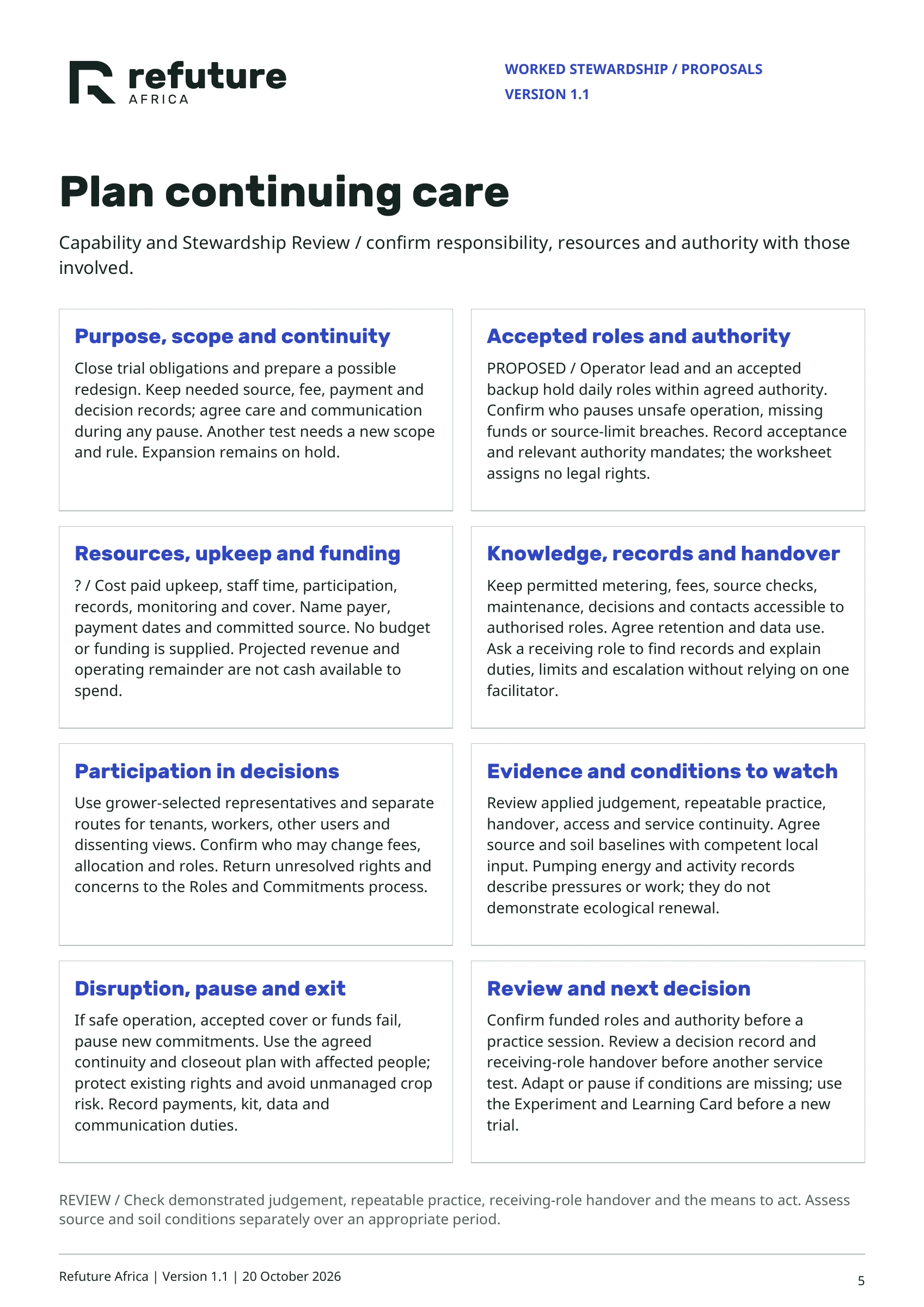
Capability & Stewardship Review — page 5: Worked stewardship / proposals
Read page 5 as text

Text follows the PDF’s reading order; use the page image to see relationships and table columns.

WORKED STEWARDSHIP / PROPOSALS VERSION 1.1 Plan continuing care Capability and Stewardship Review / confirm responsibility, resources and authority with those involved. Purpose, scope and continuity Close trial obligations and prepare a possible redesign. Keep needed source, fee, payment and decision records; agree care and communication during any pause. Another test needs a new scope and rule. Expansion remains on hold. Accepted roles and authority PROPOSED / Operator lead and an accepted backup hold daily roles within agreed authority. Confirm who pauses unsafe operation, missing funds or source-limit breaches. Record acceptance and relevant authority mandates; the worksheet assigns no legal rights. Resources, upkeep and funding ? / Cost paid upkeep, staff time, participation, records, monitoring and cover. Name payer, payment dates and committed source. No budget or funding is supplied. Projected revenue and operating remainder are not cash available to spend. Knowledge, records and handover Keep permitted metering, fees, source checks, maintenance, decisions and contacts accessible to authorised roles. Agree retention and data use. Ask a receiving role to find records and explain duties, limits and escalation without relying on one facilitator. Participation in decisions Use grower-selected representatives and separate routes for tenants, workers, other users and dissenting views. Confirm who may change fees, allocation and roles. Return unresolved rights and concerns to the Roles and Commitments process. Evidence and conditions to watch Review applied judgement, repeatable practice, handover, access and service continuity. Agree source and soil baselines with competent local input. Pumping energy and activity records describe pressures or work; they do not demonstrate ecological renewal. Disruption, pause and exit If safe operation, accepted cover or funds fail, pause new commitments. Use the agreed continuity and closeout plan with affected people; protect existing rights and avoid unmanaged crop risk. Record payments, kit, data and communication duties. Review and next decision Confirm funded roles and authority before a practice session. Review a decision record and receiving-role handover before another service test. Adapt or pause if conditions are missing; use the Experiment and Learning Card before a new trial. REVIEW / Check demonstrated judgement, repeatable practice, receiving-role handover and the means to act. Assess source and soil conditions separately over an appropriate period. Refuture Africa | Version 1.1 | 20 October 2026 5

6 / Review, evidence and use

Open full-size page 6 in a new tab ↗
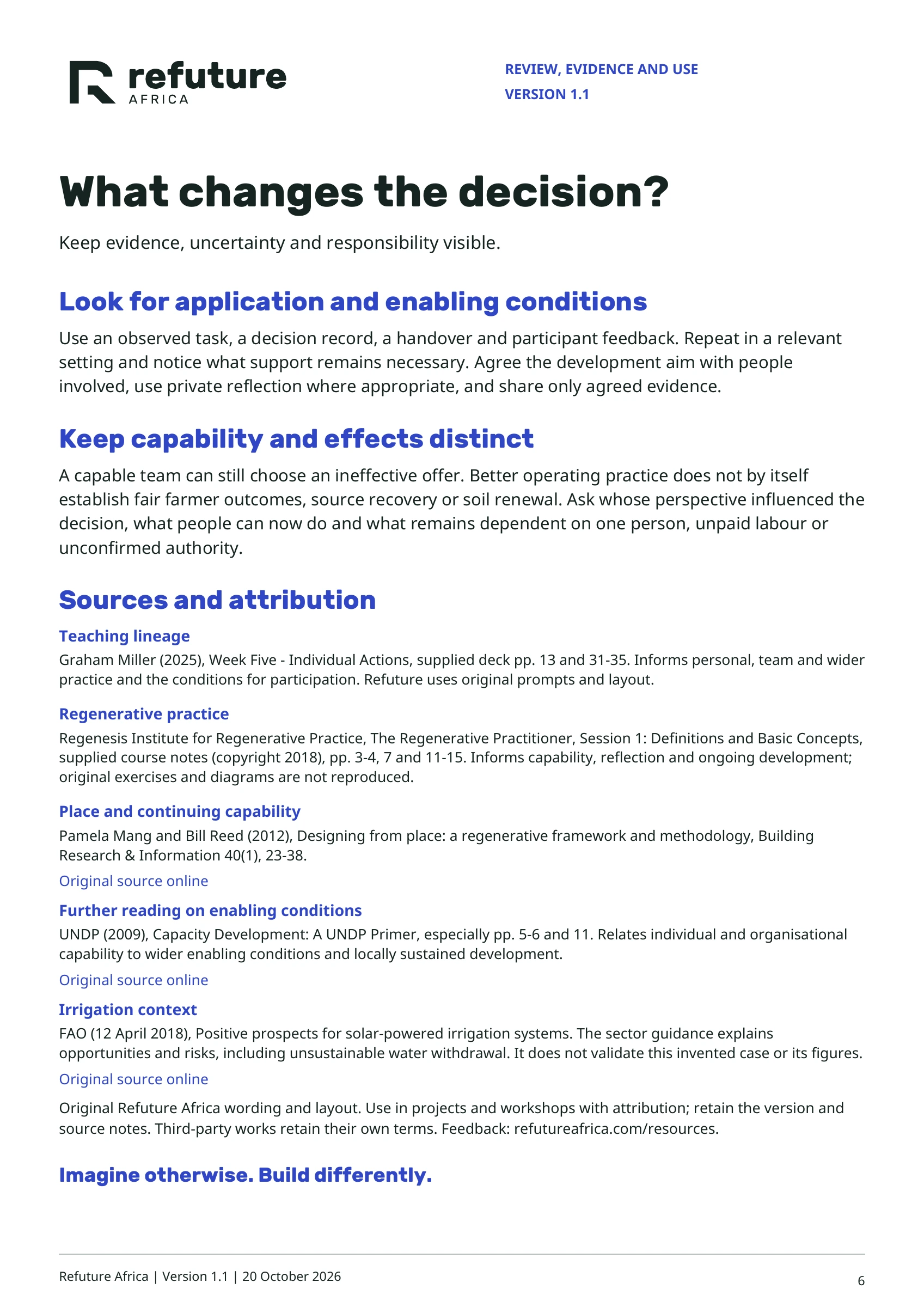
Capability & Stewardship Review — page 6: Review, evidence and use
Read page 6 as text

Text follows the PDF’s reading order; use the page image to see relationships and table columns.

REVIEW, EVIDENCE AND USE VERSION 1.1 What changes the decision? Keep evidence, uncertainty and responsibility visible. Look for application and enabling conditions Use an observed task, a decision record, a handover and participant feedback. Repeat in a relevant setting and notice what support remains necessary. Agree the development aim with people involved, use private reflection where appropriate, and share only agreed evidence. Keep capability and effects distinct A capable team can still choose an ineffective offer. Better operating practice does not by itself establish fair farmer outcomes, source recovery or soil renewal. Ask whose perspective influenced the decision, what people can now do and what remains dependent on one person, unpaid labour or unconfirmed authority. Sources and attribution Teaching lineage Graham Miller (2025), Week Five - Individual Actions, supplied deck pp. 13 and 31-35. Informs personal, team and wider practice and the conditions for participation. Refuture uses original prompts and layout. Regenerative practice Regenesis Institute for Regenerative Practice, The Regenerative Practitioner, Session 1: Definitions and Basic Concepts, supplied course notes (copyright 2018), pp. 3-4, 7 and 11-15. Informs capability, reflection and ongoing development; original exercises and diagrams are not reproduced. Place and continuing capability Pamela Mang and Bill Reed (2012), Designing from place: a regenerative framework and methodology, Building Research & Information 40(1), 23-38. Original source online Further reading on enabling conditions UNDP (2009), Capacity Development: A UNDP Primer, especially pp. 5-6 and 11. Relates individual and organisational capability to wider enabling conditions and locally sustained development. Original source online Irrigation context FAO (12 April 2018), Positive prospects for solar-powered irrigation systems. The sector guidance explains opportunities and risks, including unsustainable water withdrawal. It does not validate this invented case or its figures. Original source online Original Refuture Africa wording and layout. Use in projects and workshops with attribution; retain the version and source notes. Third-party works retain their own terms. Feedback: refutureafrica.com/resources. Imagine otherwise. Build differently. Refuture Africa | Version 1.1 | 20 October 2026 6

Ready to use it?

Download the fillable PDF to type into the worksheets or print them at the sizes shown in the guide.

Get the fillable PDF

Tell us what helped or was unclear →

Explore all eight tools →