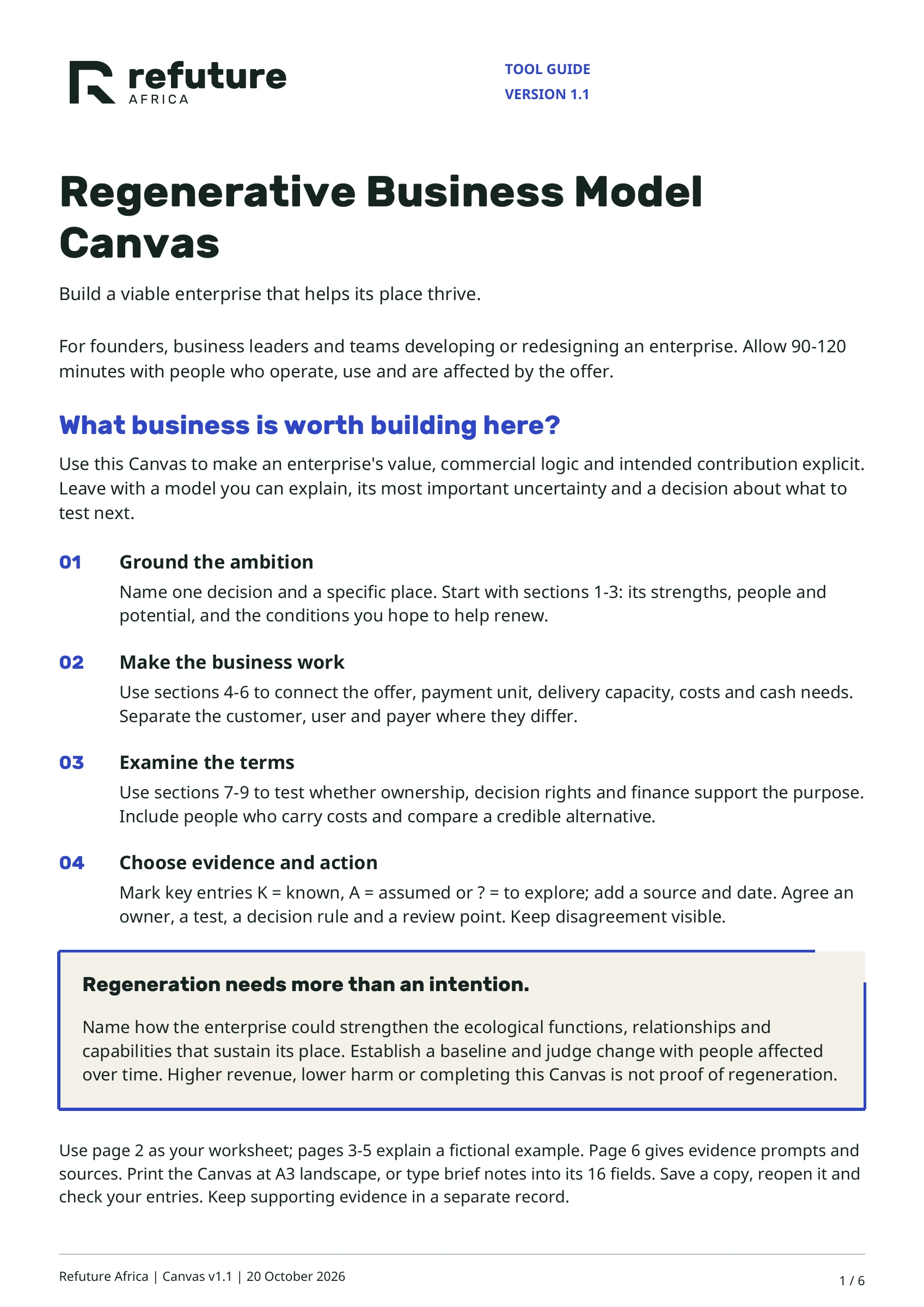
Read page 1 as text
Text follows the PDF’s reading order; use the page image to see relationships and table columns.
TOOL GUIDE
VERSION 1.1
Regenerative Business Model
Canvas
Build a viable enterprise that helps its place thrive.
For founders, business leaders and teams developing or redesigning an enterprise. Allow 90-120
minutes with people who operate, use and are affected by the offer.
What business is worth building here?
Use this Canvas to make an enterprise's value, commercial logic and intended contribution explicit.
Leave with a model you can explain, its most important uncertainty and a decision about what to
test next.
01
Ground the ambition
Name one decision and a specific place. Start with sections 1-3: its strengths, people and
potential, and the conditions you hope to help renew.
02
Make the business work
Use sections 4-6 to connect the offer, payment unit, delivery capacity, costs and cash needs.
Separate the customer, user and payer where they differ.
03
Examine the terms
Use sections 7-9 to test whether ownership, decision rights and finance support the purpose.
Include people who carry costs and compare a credible alternative.
04
Choose evidence and action
Mark key entries K = known, A = assumed or ? = to explore; add a source and date. Agree an
owner, a test, a decision rule and a review point. Keep disagreement visible.
Regeneration needs more than an intention.
Name how the enterprise could strengthen the ecological functions, relationships and
capabilities that sustain its place. Establish a baseline and judge change with people affected
over time. Higher revenue, lower harm or completing this Canvas is not proof of regeneration.
Use page 2 as your worksheet; pages 3-5 explain a fictional example. Page 6 gives evidence prompts and
sources. Print the Canvas at A3 landscape, or type brief notes into its 16 fields. Save a copy, reopen it and
check your entries. Keep supporting evidence in a separate record.
Refuture Africa | Canvas v1.1 | 20 October 2026
1 / 6
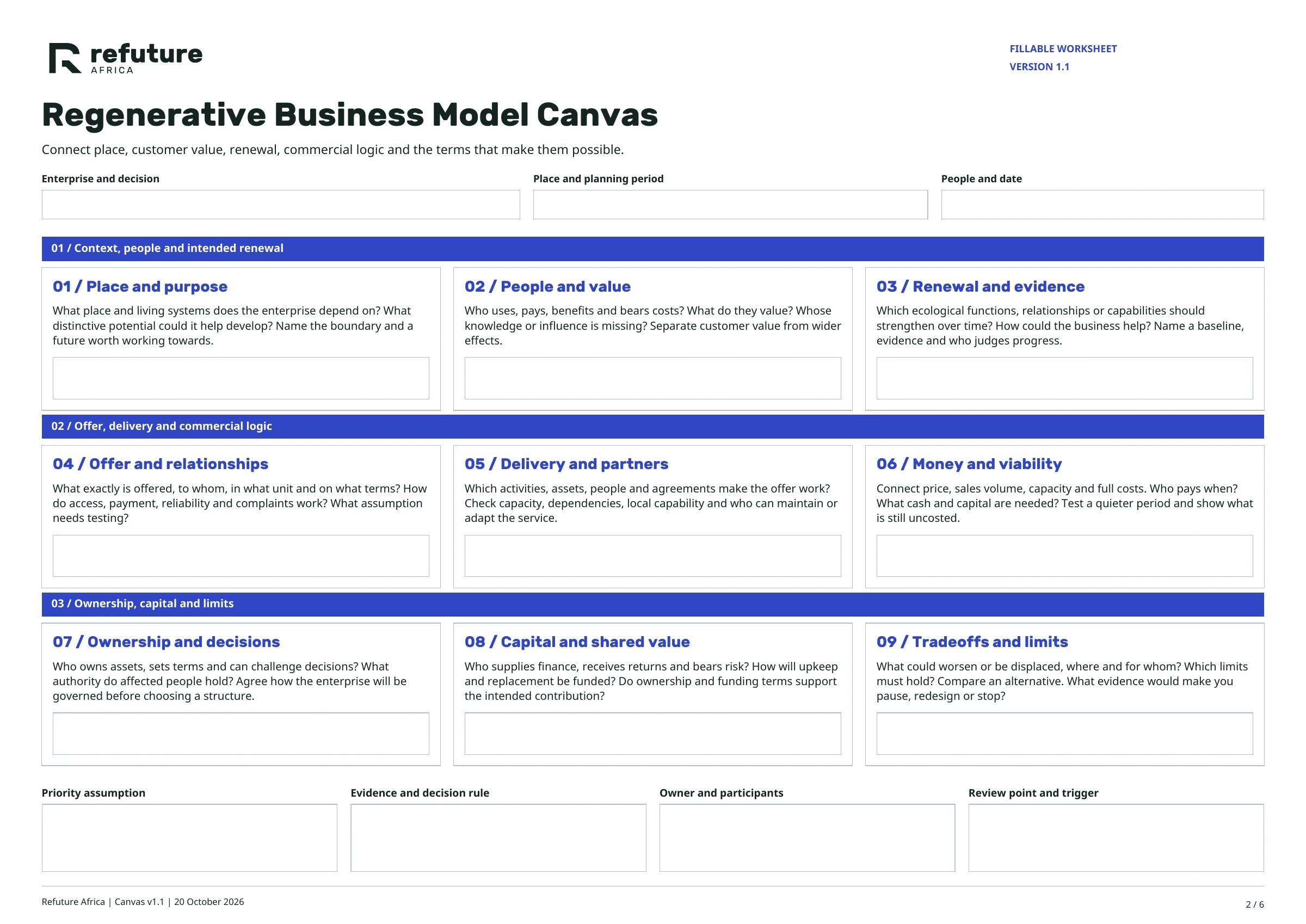
Read page 2 as text
Text follows the PDF’s reading order; use the page image to see relationships and table columns.
FILLABLE WORKSHEET
VERSION 1.1
Regenerative Business Model Canvas
Connect place, customer value, renewal, commercial logic and the terms that make them possible.
Enterprise and decision
Place and planning period
People and date
01 / Context, people and intended renewal
01 / Place and purpose
What place and living systems does the enterprise depend on? What
distinctive potential could it help develop? Name the boundary and a
future worth working towards.
02 / People and value
Who uses, pays, benefits and bears costs? What do they value? Whose
knowledge or influence is missing? Separate customer value from wider
effects.
03 / Renewal and evidence
Which ecological functions, relationships or capabilities should
strengthen over time? How could the business help? Name a baseline,
evidence and who judges progress.
02 / Offer, delivery and commercial logic
04 / Offer and relationships
What exactly is offered, to whom, in what unit and on what terms? How
do access, payment, reliability and complaints work? What assumption
needs testing?
05 / Delivery and partners
Which activities, assets, people and agreements make the offer work?
Check capacity, dependencies, local capability and who can maintain or
adapt the service.
06 / Money and viability
Connect price, sales volume, capacity and full costs. Who pays when?
What cash and capital are needed? Test a quieter period and show what
is still uncosted.
03 / Ownership, capital and limits
07 / Ownership and decisions
Who owns assets, sets terms and can challenge decisions? What
authority do affected people hold? Agree how the enterprise will be
governed before choosing a structure.
08 / Capital and shared value
Who supplies finance, receives returns and bears risk? How will upkeep
and replacement be funded? Do ownership and funding terms support
the intended contribution?
09 / Tradeoffs and limits
What could worsen or be displaced, where and for whom? Which limits
must hold? Compare an alternative. What evidence would make you
pause, redesign or stop?
Priority assumption
Evidence and decision rule
Owner and participants
Review point and trigger
Refuture Africa | Canvas v1.1 | 20 October 2026
2 / 6
Read page 3 as text
Text follows the PDF’s reading order; use the page image to see relationships and table columns.
TEACHING CASE
VERSION 1.1
Solar irrigation as a service
Could better irrigation create more value without exhausting its source?
Read this as a design exercise.
A fictional teaching venture. All participants, prices, volumes, costs and test thresholds are
invented. No field results or Refuture project are represented.
The decision
Should a local operator run a bounded paid trial before committing to equipment finance?
The place and participants
Twenty neighbouring growers each cultivate a quarter-acre vegetable plot: five acres in total. The
proposed service uses an existing shared water source in an unnamed Kenyan farming area.
Access rights, available water and system capacity still need checking.
The offer and customer value
Growers pay for metered supplementary irrigation delivered to their plots, rather than buying a
pump. The proposed operator supplies the equipment, scheduling, operation and maintenance.
Growers continue to choose and manage their crops, with agreed crop-water advice. The
commercial proposition is better crop quality, more reliable production and improved crop
margins after fees. Stronger soil health and local capability are longer-term intentions that require
deliberate practice and separate evidence.
The tension to design around
A fee for each cubic metre makes the service simple to explain, but can reward selling more water.
A viable enterprise must work inside an agreed water budget. If the price or funding model
requires over-pumping, redesign the model.
The teaching model assumes demand; it does not establish willingness to pay, water availability, legal
permission, kit capacity, agronomic suitability or financeability. These are decisions to investigate, not
facts to fill in later.
Refuture Africa | Canvas v1.1 | 20 October 2026
3 / 6
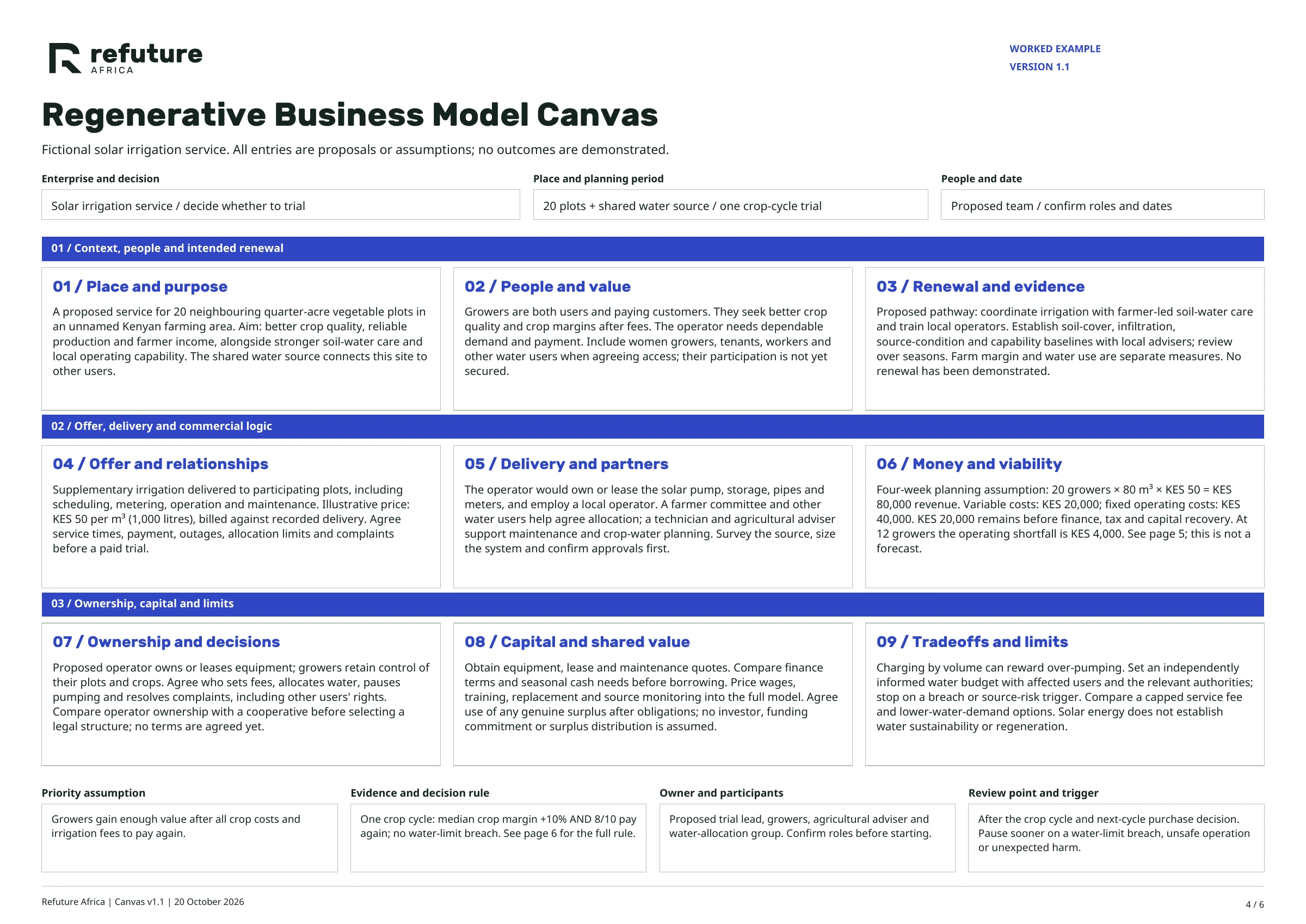
Read page 4 as text
Text follows the PDF’s reading order; use the page image to see relationships and table columns.
WORKED EXAMPLE
VERSION 1.1
Regenerative Business Model Canvas
Fictional solar irrigation service. All entries are proposals or assumptions; no outcomes are demonstrated.
Enterprise and decision
Solar irrigation service / decide whether to trial
Place and planning period
20 plots + shared water source / one crop-cycle trial
People and date
Proposed team / confirm roles and dates
01 / Context, people and intended renewal
01 / Place and purpose
A proposed service for 20 neighbouring quarter-acre vegetable plots in
an unnamed Kenyan farming area. Aim: better crop quality, reliable
production and farmer income, alongside stronger soil-water care and
local operating capability. The shared water source connects this site to
other users.
02 / People and value
Growers are both users and paying customers. They seek better crop
quality and crop margins after fees. The operator needs dependable
demand and payment. Include women growers, tenants, workers and
other water users when agreeing access; their participation is not yet
secured.
03 / Renewal and evidence
Proposed pathway: coordinate irrigation with farmer-led soil-water care
and train local operators. Establish soil-cover, infiltration,
source-condition and capability baselines with local advisers; review
over seasons. Farm margin and water use are separate measures. No
renewal has been demonstrated.
02 / Offer, delivery and commercial logic
04 / Offer and relationships
Supplementary irrigation delivered to participating plots, including
scheduling, metering, operation and maintenance. Illustrative price:
KES 50 per m³ (1,000 litres), billed against recorded delivery. Agree
service times, payment, outages, allocation limits and complaints
before a paid trial.
05 / Delivery and partners
The operator would own or lease the solar pump, storage, pipes and
meters, and employ a local operator. A farmer committee and other
water users help agree allocation; a technician and agricultural adviser
support maintenance and crop-water planning. Survey the source, size
the system and confirm approvals first.
06 / Money and viability
Four-week planning assumption: 20 growers × 80 m³ × KES 50 = KES
80,000 revenue. Variable costs: KES 20,000; fixed operating costs: KES
40,000. KES 20,000 remains before finance, tax and capital recovery. At
12 growers the operating shortfall is KES 4,000. See page 5; this is not a
forecast.
03 / Ownership, capital and limits
07 / Ownership and decisions
Proposed operator owns or leases equipment; growers retain control of
their plots and crops. Agree who sets fees, allocates water, pauses
pumping and resolves complaints, including other users' rights.
Compare operator ownership with a cooperative before selecting a
legal structure; no terms are agreed yet.
08 / Capital and shared value
Obtain equipment, lease and maintenance quotes. Compare finance
terms and seasonal cash needs before borrowing. Price wages,
training, replacement and source monitoring into the full model. Agree
use of any genuine surplus after obligations; no investor, funding
commitment or surplus distribution is assumed.
09 / Tradeoffs and limits
Charging by volume can reward over-pumping. Set an independently
informed water budget with affected users and the relevant authorities;
stop on a breach or source-risk trigger. Compare a capped service fee
and lower-water-demand options. Solar energy does not establish
water sustainability or regeneration.
Priority assumption
Growers gain enough value after all crop costs and
irrigation fees to pay again.
Evidence and decision rule
One crop cycle: median crop margin +10% AND 8/10 pay
again; no water-limit breach. See page 6 for the full rule.
Owner and participants
Proposed trial lead, growers, agricultural adviser and
water-allocation group. Confirm roles before starting.
Review point and trigger
After the crop cycle and next-cycle purchase decision.
Pause sooner on a water-limit breach, unsafe operation
or unexpected harm.
Refuture Africa | Canvas v1.1 | 20 October 2026
4 / 6
Read page 5 as text
Text follows the PDF’s reading order; use the page image to see relationships and table columns.
TEACHING CASE / ARITHMETIC
VERSION 1.1
Does the model hold?
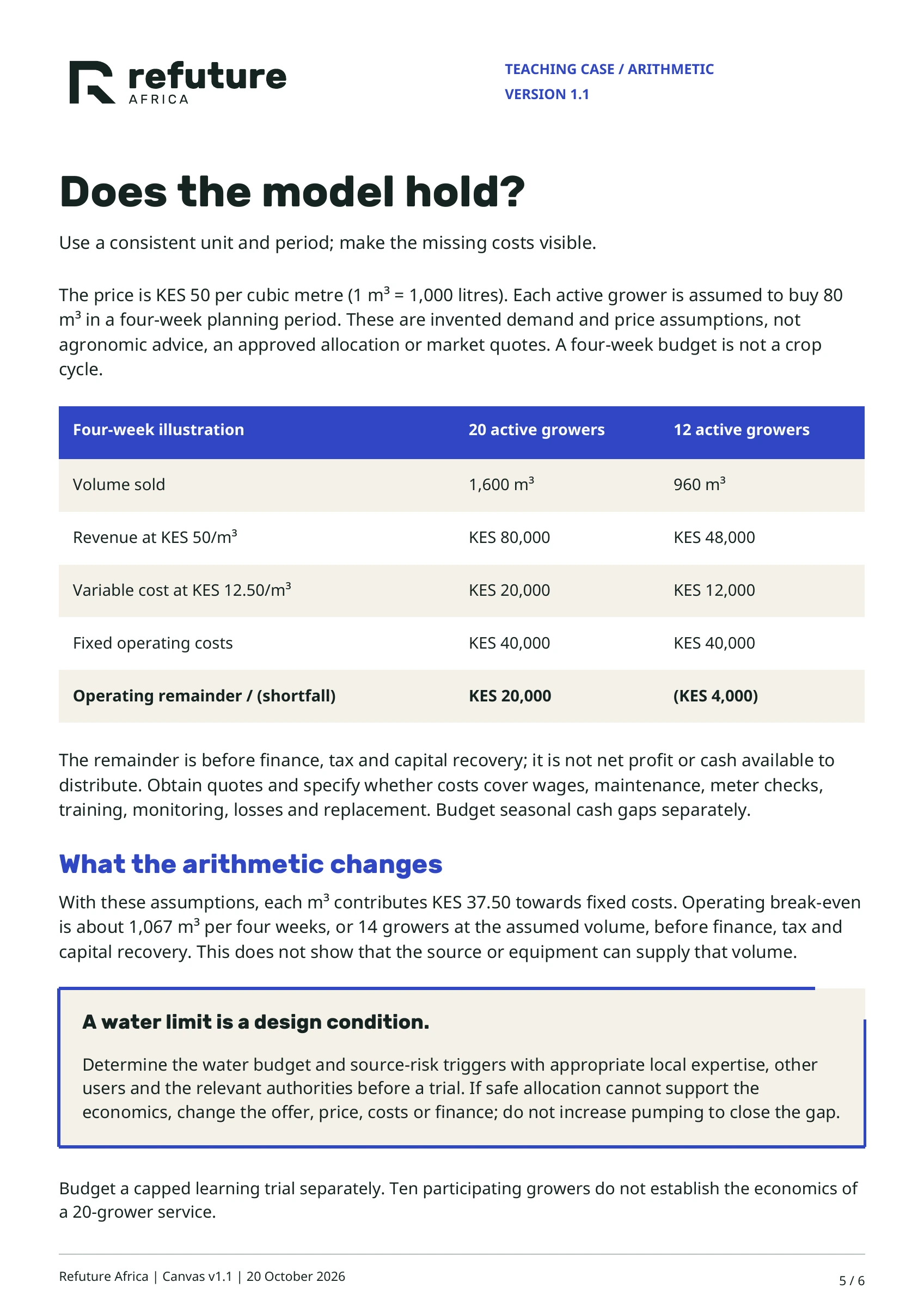
Use a consistent unit and period; make the missing costs visible.
The price is KES 50 per cubic metre (1 m³ = 1,000 litres). Each active grower is assumed to buy 80
m³ in a four-week planning period. These are invented demand and price assumptions, not
agronomic advice, an approved allocation or market quotes. A four-week budget is not a crop
cycle.
Four-week illustration
20 active growers
12 active growers
Volume sold
1,600 m³
960 m³
Revenue at KES 50/m³
KES 80,000
KES 48,000
Variable cost at KES 12.50/m³
KES 20,000
KES 12,000
Fixed operating costs
KES 40,000
KES 40,000
Operating remainder / (shortfall)
KES 20,000
(KES 4,000)
The remainder is before finance, tax and capital recovery; it is not net profit or cash available to
distribute. Obtain quotes and specify whether costs cover wages, maintenance, meter checks,
training, monitoring, losses and replacement. Budget seasonal cash gaps separately.
What the arithmetic changes
With these assumptions, each m³ contributes KES 37.50 towards fixed costs. Operating break-even
is about 1,067 m³ per four weeks, or 14 growers at the assumed volume, before finance, tax and
capital recovery. This does not show that the source or equipment can supply that volume.
A water limit is a design condition.
Determine the water budget and source-risk triggers with appropriate local expertise, other
users and the relevant authorities before a trial. If safe allocation cannot support the
economics, change the offer, price, costs or finance; do not increase pumping to close the gap.
Budget a capped learning trial separately. Ten participating growers do not establish the economics of
a 20-grower service.
Refuture Africa | Canvas v1.1 | 20 October 2026
5 / 6
Read page 6 as text
Text follows the PDF’s reading order; use the page image to see relationships and table columns.
EVIDENCE, LEARNING AND USE
VERSION 1.1
Test the value. Keep learning.
One bounded test before a larger commitment
Trial one full crop cycle with 10 consenting growers and matched plots or a credible baseline. Record
output, crop quality, revenue, all crop costs, fees and water delivered. The percentage rule requires
positive comparison margins; otherwise agree an absolute gain in KES beforehand. Record
comparison limits; differences alone do not establish causation.
Illustrative rule, agreed before starting: at least 10% median improvement in crop margin after all crop
costs and fees AND 8 of 10 growers actually pay for another cycle. All water and safety limits must
hold. These are teaching thresholds, not validated benchmarks. Review after the crop cycle and
next-cycle payment decision; redesign if the combined rule is missed. No trial result is supplied.
Evidence of renewal takes longer
With growers and appropriate advisers, define how soil cover, infiltration, source condition and local
operating capability should change over seasons. Establish initial measures and review dates. An
operator should be able to maintain the kit, explain allocation rules and act on a source-risk trigger.
Keep these outcomes distinct from sales, farmer margin and pumping energy.
Sources and attribution
Research foundation
Isaac Jumba (2026). Designing for Regeneration: A Venture Studio Model to Build Regenerative Ventures in Africa,
section 5.1 and appendices G, I and X. This Canvas applies a place-based, capability-building approach to enterprise
design.
Business modelling
Osterwalder and Pigneur / Strategyzer. Business Model Canvas. A reference for making an enterprise's value and
commercial logic explicit. Refuture uses its own prompts and a different nine-section layout.
Read the original source online
Further conceptual reading
Upward, A. and Jones, P. (2016). An Ontology for Strongly Sustainable Business Models: Defining an Enterprise
Framework Compatible With Natural and Social Science. Organization & Environment, 29(1), 97-123.
Read the original source online
Irrigation context
FAO (12 April 2018). Positive prospects for solar-powered irrigation systems, accompanying The benefits and risks of
solar-powered irrigation: a global overview. It explains both opportunities and the need to guard against unsustainable
water withdrawal. This sector evidence does not validate the fictional venture or its numbers.
Read the original source online
Original Refuture Africa wording and layout. Use this tool in projects and workshops with attribution; retain the
version and source notes. Third-party works keep their own terms. Share feedback at refutureafrica.com/resources.
Imagine otherwise. Build differently.
Refuture Africa | Canvas v1.1 | 20 October 2026
6 / 6